Dialogues on Dress: Esther Marquis
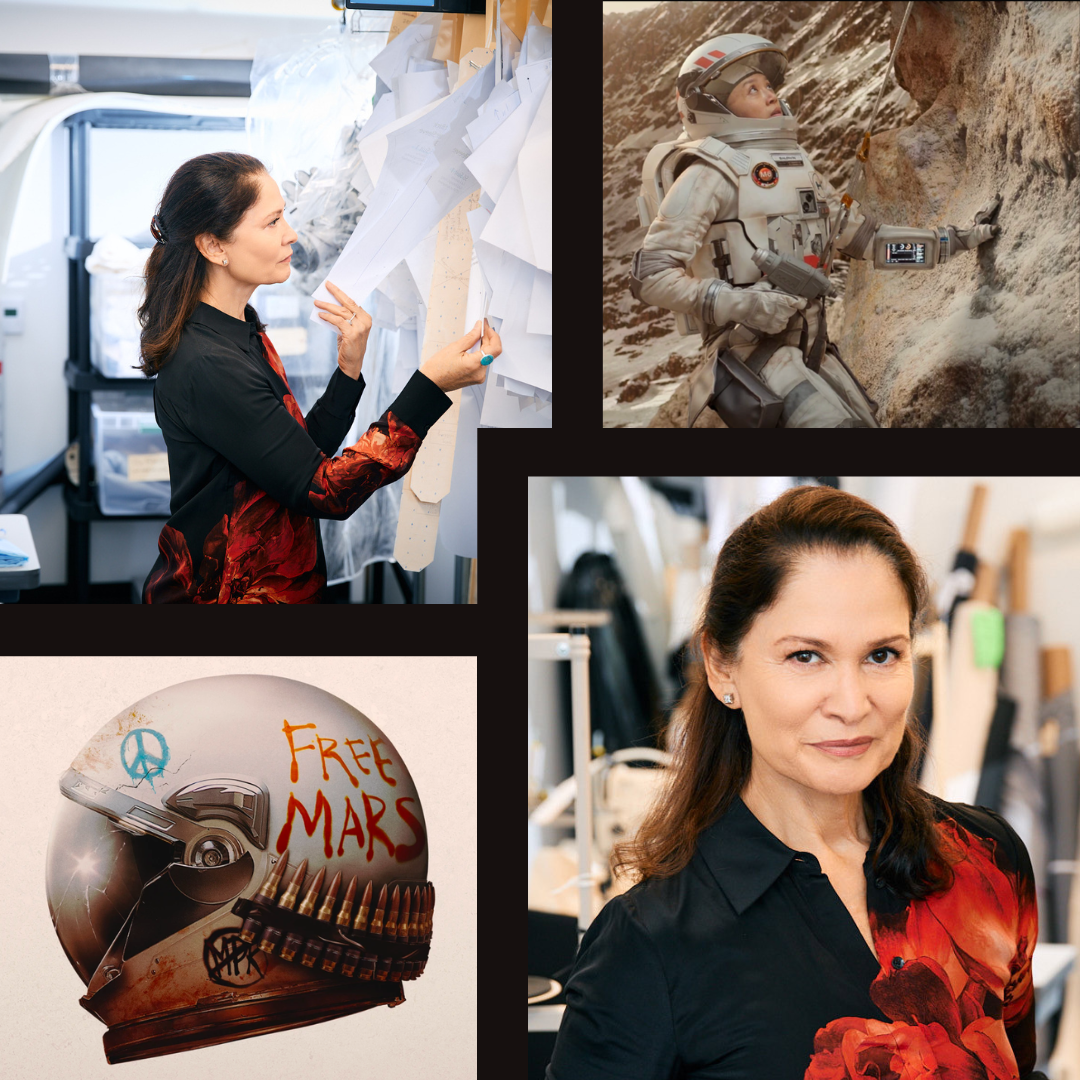
This month we spoke with Esther Marquis, Costume Designer of Apple TV's For All Mankind.
The history of dress and the future of fashion act in dialogue, always interfacing to inform our present moment. The Costume Society of America’s diverse members exemplify this reality like no other; through the constant connections across time and disciplines they draw, our membership of costume curators, designers, artists, and so much more embody fashion’s ubiquitous presence—and dress’s daily power to teach us all something new.
We hope you will join us for CSA’s new Dialogues on Dress series, interviews now available monthly in our e-News and here on our website.
Interested in getting in touch? Email enews@costumesocietyamerica.com
Dialogues on Dress: Esther Marquis
Esther Marquis’s work has probably graced your screen on more than one occasion: whether you’re a fan of arthouse cinema and saw The Tree of Life; partial to action or comedy and loved The Nice Guys; or more into TV with mega hits like Westworld and The Morning Show, she was on the costume team for them all. Her most recent endeavor as Costume Designer of Apple TV’s For All Mankind marks an apex in her career, and is a substantial topic of our conversation, but the years leading up to this were full of dress work running the gamut—from her roots in theater costume design to working on a museum exhibition at a UNESCO World Heritage Site. Even now, Esther designs not just for the camera, but for real life astronauts alike; in 2024, Axiom Space commissioned a flight suit from her. Below, we discuss the demands of being both an artist and a leader, designing for the stage versus camera, and whether those spacesuits in For All Mankind could really go into space.
This interview has been edited and condensed for clarity.
___________________________________________________
Please paint a sketch of your background–personal, academic, & professional. What did your journey to arriving at costume design entail, and what has your personal relationship to dress looked like over the years?
I was born and raised in Perth, Western Australia. I completed an art degree focusing on costume design at Perth Technical College, now the Institute of Contemporary Art, but my education never felt complete and the limitations were evident. As I searched around for the right education fit, I was admitted into Boston University for my BFA, then subsequently my MFA. Both were in Costume Design. It was an incredible experience, and I’m eternally grateful I received my education from such a well-respected institution.
I have always been passionate about clothing. I remember when I was maybe six or seven, my mother—who was not particularly into fashion and was very busy working—made a dress for one of my dolls. I distinctly remember the fabric she used and the style she made for it. My first thought was, ‘oh no, she’s got it all wrong.’ I took a pair of sheers and cut off the chiffon overlay to reveal the eyelet skirt underneath, satisfied I had improved the outfit she had spent a lot of time making. Needless to say, my mother did not make another piece of doll clothing. Looking back, this felt like the beginnings of my costume path. As I reflect on my early influences, I find that my exposure to the arts and crafts of other cultures, including my father's Goan roots, was significant. My interactions with relatives in India greatly impacted my awareness and interest in fabrics, design, and color.
My relationship with dress has always been exploratory; I am driven by a desire to learn and to decode the intricacies of clothing patterning and design. I imagine many historians share this same perspective.
Were your initial interests in television & film or were they in theater? How did your career evolve post-education?
The interest for costuming in general was always there, for both film and theater. Back in the ‘70s, the Australian film industry was finding its footing, with the release of movies like Picnic at Hanging Rock and Gallipoli. Australians were delving into their own past, and those early movies definitely captured my imagination. After graduating from BU, I became design assistant to Susan Tsu, a gifted designer and a terrific mentor. Beginning my professional career in theater was a wonderful place to hone my craft, explore the industry, and expand my notion of what costume design can be. After assisting for a few years, I then stepped into the design role, working in notable theaters around the US. The Alley Theater (Houston) was my artistic home, and offered many challenging design opportunities. My designs bookended their Tony award winning season. Working in theater in this capacity, allowed me to work closely with actors and focus on designing around character development.
The collaborative environment of theater served as a wonderful training ground for the work I do now. The transition from theater to film & television was a product of two things: needing healthcare and the growth of Austin’s own TV and Film industry. The transition was natural, and I started working as a tailor, draper, and textile person. I felt that I needed to understand the medium better and work through the different positions before jumping into a design role. TV and film are very demanding, and having a solid base grounds your choices. I believe experience is often undervalued, when in fact, the majority of my problem-solving ideas are directly informed by my past experiences.
~Designing for the camera also has very different demands than designing for the live audience. You’re thinking about what the camera sees, how it picks up colors. There is much more territory to cover, like considering stunts or character arcs across multiple seasons vs. a couple of hours [in a play].~
How does costume design for film and television differ from designing for theater?
The biggest difference is production time and content flow. With theater, you get X number of weeks in rehearsal/production time where you’re designing and building, then comes dress rehearsal and opening night. It’s a very set timeframe. In theater, you’re creating clothing that is viewed live, from a distance, so you’re looking at a different set of questions. It has nuances, but it is more straightforward because there is a clear start and finish. In TV & Film, there isn’t really a start to finish through line with shooting. There is of course a script, character development, and time lines, but that is not the way it is shot. You’re shooting scenes out of sequence, you’re accommodating script rewrites, you’re dressing large numbers of background, and you’re costuming for stunt work. You’re constantly revisiting material. Designing for the camera also has very different demands than designing for the live audience. You’re thinking about what the camera sees, how it picks up colors. There is much more territory to cover, like considering stunts or character arcs across multiple seasons vs. a couple of hours [in a play]. There are generally a lot more characters and a lot more costumes. For this last season of For All Mankind, I had over 500 fittings.
I would love to hear more For All Mankind on Apple TV and how you got started working on that show.
I was back in Sydney, Australia (during Covid) working on a Marvel production as the Head Textile Artist. It was a good time to think about the future and one’s career, and I decided to pivot back into design. This led to an assistant role on the third season of For All Mankind. The designer wasn’t able to continue midway through the season and because of the pace and demands of the show, I stepped into the designer role. While the transition was daunting, the support from the show runners made the experience incredibly rewarding.
Building on that momentum, I designed a new spacesuit for the show's fourth season. I also collaborated with Axiom Space in Houston. After my submission for a new spacesuit cover was accepted, they commissioned me to design the flight suits for the Axiom Mission 3 (Ax-3) to the International Space Station. Seeing my designs actually go into space has been an extraordinary highlight and provided invaluable technical insight for my work on the show.
The spacesuits you make for the show, could those actually go into space?
Definitely not. A real spacesuit is like a small, personal spacecraft. You’re wearing your life support system and backup systems–they are super heavy, bulky, and full of technology. They’re very complicated technical pieces of equipment. Our show suits are quite different; they’re built for usability, movement, stunts, character, etc. But we do have to address some of the same issues, like how to breathe in the helmet, sight lines, and fingertip agility. We have built in safety features so they can get their suits off quickly. Our show strives to be as realistic as possible by addressing the same design questions that real-world aerospace designers encounter.
Are actors involved in the process of costume design?
Absolutely. With the returning cast the conversations are about transitions and the characters mental and physical development. With each costume fitting the exploration continues as the scripts develop. Theater training was wonderful for this because I spent so much time in conversation with actors. You have to be very fluid and flexible when it comes to designing for a character; it’s a collaborative effort.
What makes For All Mankind uniquely challenging is the 10-year passage of time in between each season. It's a new design equation at the beginning of every season. You've got a 10-year history that you also have to think about–questions of aging, and changing physicality, of our main characters, not to mention the introduction of new cast members. So many conversations go into this process.
~A lot of people are driven by fear, which is a terrible place to make decisions from. You can’t design well if you feel like you’re fighting for your life. You need to be in a very secure position, and that security comes from education and experience.~
What advice would you give to someone interested in a similar line of work, just starting out in their career?
Two words: education and experience. The learning process and creating a solid foundation is crucial. A lot of people are driven by fear, which is a terrible place to make decisions from. You can’t design well if you feel like you’re fighting for your life. You need to be in a very secure position, and that security comes from education and experience. Both make you a better problem solver.
As a department head, I imagine leadership skills are top of mind?
This is a huge part of my job. Giving direction and inspiring people can be an interesting role for an artist to step into. I am in my own head most of the time, and that stands in opposition with what is required of a leader. I am still learning, and it’s a wonderful feeling when I get it right. Our particular show requires a lot of exploration and imagination, so being able to inspire people to take risks and think big is crucial.
~Giving direction and inspiring people can be an interesting role for an artist to step into. I am in my own head most of the time, and that stands in opposition with what is required of a leader. I am still learning, and it’s a wonderful feeling when I get it right.~
What does your personal relationship to fashion look like?
I’ve always loved fashion, but as a teenager I could never afford it. I think that’s why I became a maker. I really appreciate the fine art aspect, draping, and tailoring. When done beautifully it can transform the body. I'm curious to see where contemporary fashion is going–there are a lot of pressures exerted on the industry right now. I am seeing a compression of the textile industry. That's having an impact on the availability of fabrics and the creation of new textiles. As a costume designer, that has a huge impact on my job. I'm always looking for new fabrics and suspect the fashion industry is experiencing the same. I'm always thinking about what's going to push us forward in clothing design and cut–it generally begins with new materials.
My thoughts about fashion have routinely been revised, however my work on a museum project for the At-Turaif Living Museum, a UNESCO World Heritage Site in Saudi Arabia really challenged my notions of craft. I was brought in to design the textiles and the costumes for their interior exhibits, which surprisingly included an Arabian Horse Exhibit. Deep diving into 17th century Arabian peninsular culture, my team focused on the simple but clever patterning of Bedouin garments, delicate embroidery and challenging weaving patterns. It gave me a whole new appreciation and respect for traditional crafts and international dress.
Any favorite fashion from films (ones that you’ve worked on or just enjoyed as a viewer)?
There's so much good costume and production design work out there. As visual technology improves and screens get bigger, the details matter even more. I loved The Great—wonderful show, smartly written, and beautifully designed. I also loved Versailles. What amazing period costuming work. As you may have guessed, I am a great admirer of period shows. We’re not seeing too many these days due to high production costs, but I would love the opportunity to work on one at some point.
Do you have any goals or dreams for the future–things you’re thinking about over the next five or so years?
The TV and Film industry are entering a significant period of change, and while the impact of AI over the next five years remains uncertain, I am eager to explore new creative opportunities in both contemporary and period costume design. I would also love another opportunity to design a futuristic spacesuit. While my aerospace design work on For All Mankind has focused on contemporary suits with a nod to the future, I am interested in fully immersing myself in a project centered on a "future suit." Having designed three different suits for the show, I have gained a high level of proficiency and a keen understanding of the historical timeline of spacesuit evolution.
What does the future of fashion look like to you?
I am always interested in future pathways, both in design and production. I’m seeing an interesting turn towards the future in Active Footwear design and production. They’re dealing with advanced fabrics and construction practices, and pushing interesting building modes. Maybe they’re leading the way in terms of our future direction for design and fabrication.
The future of fashion in my view hinges on addressing environmental and production practices. Industries that create clothing like fashion, TV, film, etc. should be working towards more equitable practices that benefit everyone now and in the future.
___________________________________________________
Thank you so much to Esther Marquis for having this conversation with me! You can learn more about her and her work here.
~Madison Brito Taylor
Images (clockwise from top left):
Photo by Patrick Strattner Photography
Photo courtesy of Sony/Apple TV, For All Mankind
Photo by Patrick Strattner Photography
Photo courtesy of Sony/Apple TV,
For All Mankind