Dialogues on Dress: Lillia Whittington
This month we spoke with Lillia Whittington, a maker, researcher, and educator whose sewing-centered practice explores creativity, connection, and the joyful, human energy of the clothes we wear.
The history of dress and the future of fashion act in dialogue, always interfacing to inform our present moment. The Costume Society of America’s diverse members exemplify this reality like no other; through the constant connections across time and disciplines they draw, our membership of costume curators, designers, artists, and so much more embody fashion’s ubiquitous presence - and dress’s daily power to teach us all something new.
We hope you will join us for CSA’s new Dialogues on Dress series, interviews now available monthly in our e-News and here on our website.
Interested in getting in touch? Email enews@costumesocietyamerica.com
Dialogues on Dress: Lillia Whittington
Sewing is in Lillia Whittington’s DNA, and while the nexus around which all her fashion endeavors operate, her story ripples out in all directions from this center of making. Be it growing her own natural dye garden, researching how technology filters into indie crafting spaces, or learning the world of PhD influencing, Lillia is always looking at the world of creation and creativity with fresh and eager eyes. She is both a student and teacher–a PhD student at Iowa State University, adjunct at Texas Women’s University in the Fashion Design department, and sewing teacher through her own business–and never short of inspiration. Her excitement for the field of dress is itself a reminder that “you’re not being graded,” playing with clothes and creating should be an act of joy and expression, not perfection and posturing. Lillia wants us all to feel a genuine connection to our clothes, “the energetic force” the things we wear and make possess, and her story will hopefully inspire you to pick up a sewing needle yourself, or perhaps just embrace a more authentic relationship to the things you wear.
This interview has been edited and condensed for clarity.
___________________________________________________
Please paint a brief sketch of your background, personal & professional.
I come from a long line of sewists, professionally speaking, and I’m fourth generation. I've been sewing since I was four. I went through phases, like middle and high school, where I thought sewing was not cool. But I started doing Winterfest competitions here in Texas, and I would make these really elaborate traditional German doll costumes for competitions. I went to state a few times, so that was really fun and got me back into sewing. I got a fashion design degree at Texas Women's University [TWU] and went right into the industry as a tech designer after graduation. I worked for a men's clothing company called Haggar for two and a half years, and then the pandemic happened. That’s when I really took a left turn into entrepreneurship and blogging full time. I began considering how to blend a career in sewing and one in entrepreneurship, and I hadn’t really thought about folding academia into that yet. But TWU reached out after a couple years and asked me to assist in some of their fashion classes. I fell in love with it. I stayed on long term, and then two years later they were looking for adjuncts–which I learned you need a Masters for. So I went to Iowa State for my Masters, and here we are today. I'm an adjunct at Texas Women’s University [in the Fashion Design department], a PhD student at Iowa State University, and I currently run what is essentially a content creator business teaching individuals how to sew online.
As you’re based in Texas but pursuing a PhD at Iowa State, is that program virtual?
It’s hybrid, which was a huge draw for me. And it is a stellar hybrid program at that. They are very adamant that they stay super connected with their hybrid graduate students and achieve that in a lot of different ways. I feel very involved in the program despite not being physically there most of the time.
My PhD topic is still in the works, but my Master’s thesis was on indie pattern makers and technology dissemination from higher corporate companies into the DIY field. So basically how technology moves through and enters into the craft space. It was really fun to learn more about a community that I'm already so involved in but on a completely different level.
Can you tell me more about your work teaching? Between your online teaching business and being an adjunct at TWU, I’m sure your courses are plentiful and varied. Do those worlds overlap much?
It's very rare that they overlap, but when they do, it's really fun. I do a lot of conference teaching; I used to do the S Expo, which is up in Puyallup, Washington, and I'll be at PatternCon in August. Tricia Camacho, another CSA member, is actually the creator of PatternCon and a good friend of mine. It’s fun to do these larger conferences, as I often am teaching in smaller workshop settings and maker’s centers. Teaching through my own business and exposure to so many different kinds of students help inform how I show up in an academic setting, and it’s just generally given me a lot of experience. I guess it has helped me approach an academic classroom with more of an open mind. All of my teaching helps with my research as well, since that’s in the DIY craft space.
I'm currently teaching a digital pattern making course, which is what my research is in: virtual pattern making softwares. I'm also teaching a draping and couture class. That's really fun because I am currently doing some research in various heirloom sewing techniques, so I'm able to bring in that research with teaching the students and letting them get a very well-rounded experience of: this is the historical context of why we're doing this, and this is the historical context of why this technique is used.
I'm also teaching a sustainable mending class. That's a new one for the university, and it’s been amazing. The students are so receptive and engaged. We’re also learning about the history of mending; one of the biggest things I consider when developing curriculum is how to make it relevant and contextual. I didn’t want the class to just be "let’s sew," I wanted to talk about how mending is relevant to the broader fashion industry. Why it is important to learn this. This sustainable mending class has all sorts of students from different departments in it, not strictly fashion students, which creates some really fun discussions and perspectives. We talk a lot about how this relates to so many industries, and how they can take these topics into their own lives and the conversations they’re having in the workplace, at home, with friends…
It’s interesting to hear about how fashion history shows up in a class like this. Does it generally play a large role in your research and teaching?
I would say this semester is definitely very heavy on the history because of this class. Fashion history is an endless source of learning. If you look at patchwork and mended pants, Ötzi is somebody who comes up, and his patchwork pants are on exhibit in Iceland. We’ve looked at that in class, or how the oldest shirt, carbon dates to maybe 5,300 years ago, is still together. How is that possible? Topics like that incite a lot of great discussion.
My current research is all about heirloom sewing, which has me of course delving into history a lot, but honestly fashion history hasn’t been a large part of my work until very recently in graduate school. Academia has really opened my mind to see the importance of learning where things came from and how they came to be. They why behind what we wear. I’m trying my best to bring that into the undergraduate courses I teach. Because it does help you be a better designer. Learning those fundamentals and foundations helps you understand why you are designing what you are, and why you are inspired by certain things. It also helps you grasp trends, and look at why trends repeat themselves and how they do. I like filling gaps in my knowledge with guest speakers. I get to learn new things that way too.
~I love to wear bright, fun colors because the world is very dark at times. It can feel so isolating. Clothing is a way you can very easily let people know that they can feel comfortable around you, that you're a safe person.~
I’d love to back track a little to talk about your personal relationship to fashion. Being a fourth generation sewist, it runs in the family, but what keeps you inspired in the field? How does your work affect how you see your own style and what you choose to wear?
Continually learning keeps me inspired; I am always learning about new techniques I want to try, so my work is always on the move. Actually learning about history and my current research in heirloom sewing techniques keeps me inspired too. We don't see that level of time and care and emotion being put into our garments anymore. A lot of us wear and then move on, that’s just how society has evolved. Reflecting on that reality and my own sustainable sewing journey, it makes me want to be even more connected to my clothes. I want to imbue it with that emotion of a handmade object, to have a story to tell with it.
As far as how I approach dress, I think it's such a reflection of who you are. I love to dress in fun colors, and I always do my best to put something on that I either made or a friend has made for me. My students notice this and will ask me about what I’m making. I think it’s great to model that, practicing what you preach. Showing them the value in wearing what you yourself created, even if it's got a little mistake here or there. It’s also a conversation piece for them, and it exposes them to different styles of sewing and lets them know that you don't just have to sew for class. You can sew for yourself.
I love to wear bright, fun colors because the world is very dark at times. It can feel so isolating. Clothing is a way you can very easily let people know that they can feel comfortable around you, that you're a safe person. As I've stepped into more of a professor position, it's become a little bit harder to kind of balance that line of fun and professional. I've been experimenting a little bit more with that idea. I use a wardrobe app called Whering that helps me play with outfits; that's been something that's helped me consume less and get to know my clothes more and have fun in my closet. It’s like the scene from Clueless, it brings me so much joy. We don’t play enough with our clothes, and that element is so important. A lack of fun or play, and a lack of getting to know your closet, I think leads to overconsumption.
Does wearing your own pieces feel different?
Very different. I'm a very big believer that whatever you make, your energy is in it. When I wear my own pieces, I have a little more pep in my step. There's nothing better than walking down the street and hearing somebody say ‘I love your outfit!’ and you get to turn around and say, ‘thanks, I made it!’ It's just a really joyful moment. It brings a smile to both our faces. And if what I’m wearing brings a smile, then I’m happy. My style isn’t for everyone, and I’ve even had some students tell me my outfits are ‘very loud.’ But you know, you remember them. It’s a conversation starter. These pieces you make yourself have an energetic force about them.
I’m doing a TedX talk in February about the resiliency that's formed within creative and craft communities. One of the sewing circles I'm in, we made an indie pattern together of falconer pants. In this TedX Talk, I’m going to talk about how we came together to make these pants and in the process it connected us to each other, ourselves, and our creativity. It also opened the door to so many other conversations within our sewing work and creative problem solving.
I always love hearing about the importance of finding community when it comes to sustainable fashion; several other CSA interviewees have talked about how pivotal this is! Beyond community, or expanding on that, I'm curious what your advice would be to someone who wants to make some of their own clothes or wants to get into mending, but doesn't know where to start?
If you have a local library that has a maker space, or if you're lucky enough to be a student who's at a university with a maker space, you probably have free access to a sewing machine. Local maker’s spaces are full of amazing tools, and often they provide free access. So you can practice and try things out before fully investing. Thankfully, we are in a time of great abundance in terms of workshops and learning opportunities. There are so many, be it virtual or in person. There are also a lot of great sewing communities, with open forums for Q&As or discussions. Ask a question, and I guarantee somebody will answer it. There are ones online, but also check for local quilting circles or sewing circles. If you live in a university town, there's probably a sewing-related club at some university or your local library that you could join. You could also ask your local library to rent a room, and start your own group. If it’s for community connection, it should be free. You can also use them for books. I'm a very big advocate for using your local library. It's your taxpayer dollars, so you already pay for it. Go use it!
You also do work in natural dyeing. I believe you even grow your own dye garden. Can you tell me about that?
Farming is a part of my life; my grandparents have a giant farm out in the country, and that's where I spent a lot of my summers. That's where I learned how to sew and farm, which is a natural thing as a Texan. I got really into dyeing in my Master’s program, and grew my own dye garden. It has had marigolds, butterfly pea flowers, madder, I even took a whack at growing indigo. That did not work out. If you’re interested in getting into natural dyeing, I would start with vegetable scraps, like carrot tops or onion skins. The Dogwood Dyer is a great resource. Here in Texas, I have a bit of a natural dyeing mentor, which has been so helpful. There is a huge science to it that a lot of people don't realize, it involves large amounts of chemicals or mordants. But there are a lot of resources and programs out there, and you can start small.
Describe a typical day of work or studies (& perhaps some leisure ) - or if no day looks the same, describe a good one.
Most weekdays are pretty similar. I'll wake up about 5:30am because I usually have an 8am class to teach. I pull a tarot card for the day, maybe journal, have some coffee, and do 30 minutes of just quiet. It’s important for me to start the day in quiet. I’ll usually teach until about 2pm then go to class for my PhD. Evenings are spent hanging out with my husband, flipping through textbooks and tabbing things, working on my research. I’m very inspired by other forms of art, as well as nature. My husband works in finance, but is an art collector too, so talking to him is always really inspiring for my work. I've really been reflecting recently about how much support I get from my spouse, and how fortunate I am for that. He makes my routine feel so much lighter and manageable.
~Do not try to force something just because it is trendy. If it feels natural, that authenticity will resonate with your audience. That’s the biggest lesson I have learned in entrepreneurship and content creation–your audience always knows. They pick up on things, and they know when you're in it and they know when you're not.~
Can you tell me more about your experience with entrepreneurship, being your own boss, and running your social media account and blog?
Being your own boss has so many pros, but also so many cons–one of which is taxes. Nobody wants to do taxes. I started doing content creation and began my blog actually all the way back in 2016. It was called the D Diaries and was about fashion in Dallas and Denton and local living. In 2021, I closed that, pivoted, and started @just.lilliaa which is all about sewing. That account has really moved me into the best stage of entrepreneurship where I’m authentically being myself. If you're an entrepreneur who is scared to pivot, just do it. Do not try to force something just because it is trendy. If it feels natural, that authenticity will resonate with your audience. That’s the biggest lesson I have learned in entrepreneurship and content creation–your audience always knows. They pick up on things, and they know when you're in it and they know when you're not. When you show up as yourself, that's when your business really shines.
The hardest part is just keeping up with it on top of all your other responsibilities. I was a full-time creator during COVID, and I had nothing but time then. But now, being a student and teacher again, there are a lot more demands on my time and it is much more of a juggling act. That’s a big place where community comes in; they help lighten the load. They encourage you and are a source of support. I don't think I'd be anywhere without the communities I have. The human experience wasn't meant to be lived alone.
There is a whole world of PhD influencers, a very niche field… I find the information out there actually very helpful. But there aren’t a lot of them in the field of design. A lot of people don’t even realize you can get a PhD in something like fashion design or apparel merchandising. I’m interested in sharing more about my students, and exposing people to this area. Undergrad is a finite period of time and you can only cover so much, but you get to explore so much with a PhD.
~People often approach sewing thinking it has to be perfect, but you’re learning a new skill. It’s not for a grade. It is so ingrained in us that we are always being graded, but the goal is just to have fun.~
What does the future of fashion look like to you?
For you to embrace your clothes, and do so in a way that is meaningful to you. In a way that isn’t influenced by trends or what other people want you to wear, but rather embracing what makes you more confident, more creative, and then encourages others to do the same.
Also, I want to say, just have fun with sewing. It’s not that deep. People often approach sewing thinking it has to be perfect, but you’re learning a new skill. It’s not for a grade. It is so ingrained in us that we are always being graded, but the goal is just to have fun.
___________________________________________________
Thank you so much to Lillia Whittington for having this conversation with me! You can find her on social media here or at her website here.
~Madison Brito Taylor
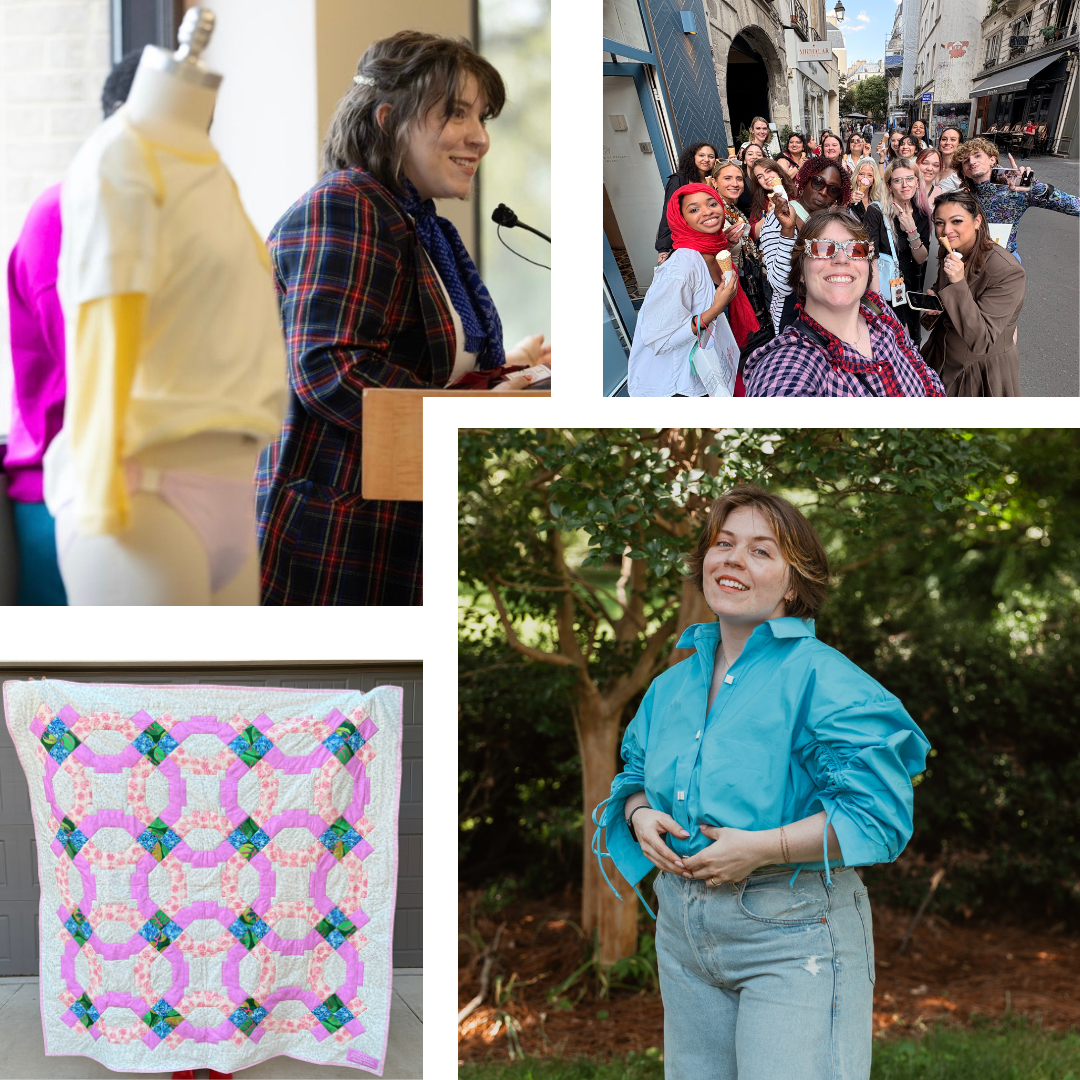
Images (clockwise from top left):
Photo by Scottish Rite [hospital] for adaptive fashion project in 2025
TWU Paris Trip in 2025
Photo by Gina Alex Creative, Charlotte, North Carolina in 2025
Community baby quilt project in 2025