Dialogues on Dress: Marie-Claire Bozant
This month we spoke with Marie-Claire Bozant, photographer and fashion collector.
The history of dress and the future of fashion act in dialogue, always interfacing to inform our present moment. The Costume Society of America’s diverse members exemplify this reality like no other; through the constant connections across time and disciplines they draw, our membership of costume curators, designers, artists, and so much more embody fashion’s ubiquitous presence—and dress’s daily power to teach us all something new.
We hope you will join us for CSA’s new Dialogues on Dress series, interviews now available monthly in our e-News and here on our website.
Interested in getting in touch? Email enews@costumesocietyamerica.com
Dialogues on Dress: Marie-Claire Bozant
Marie-Claire Bozant sees fashion with fresh eyes. As a photographer, she is gifted in capturing the way energy is held in a space; as a collector, she is trained to look at clothing as characters with full and rich backgrounds to uncover; and as a fashion-lover, she is a fierce advocate for approaching dress as both a subject of consequence and of play. Marie-Claire has charted an adventurous life, and not strictly speaking to the limited confines of ‘career,’ from growing up in a family of artists and moving about the world, to studying fine arts and teaching photography across the US, to becoming a bonafide fashion collector and Tina Leser expert; Marie-Claire spent years learning the rules of what ‘art’ is—what a profession in this world ‘should’ look like—in order to break them, aptly proving that really, there are no rules at all. Much like the kind of dress she wants to see more of in the world (i.e. a little more brave and thoughtful, a little less simple for the sake of safety), Marie-Claire’s path in photography and fashion feels authentic, modern, and inspiring. Read on to hear her discuss getting into collecting, letting your interests grow naturally, searching for community, and much more.
This interview has been edited and condensed for clarity.
___________________________________________________
Paint me a picture of your personal and professional background. From your earliest memories of fashion, to your education and the career you have today.
I got into fashion when I was a kid because of Vogue magazine. I fell in love with the photography first, maybe when I was just seven or eight. A love of fashion grew out of years of reading magazines, and also from a very creative family. My mom sewed a lot–she had a general interest in fashion, we always bought secondhand–and my dad and my sister are both painters, so a love for art felt very ingrained. I started doing a lot of photography as a teenager, then went to school for it [a BFA in studio art from University of New Mexico and MFA from University of Washington in an interdisciplinary fine arts program], then taught photography and art history and design at various places. At UNM I studied with Adrienne Salinger—she did Teenagers in Their Bedrooms. I loved her work, so it was amazing to study with her. My interest in fashion was always kind of a background thing for a long time.
For a while, I primarily worked in fine art photography. I was always interested in empty spaces, architectural interiors, that kind of stuff. I guess I always kind of inserted myself and clothes into the photographs, but I never took that seriously. I was taught to believe the fine art stuff was more “serious.” It’s interesting to come from a very academic background where there are rules telling you “this is what art is and this is what isn’t.” I still have a little weirdness around saying that this is my art now—wearing clothes, photographing clothes, and collecting vintage—but it’s what I love to do, and it’s what I’ve ended up doing.
I don’t know how to describe it as a career or make it sound cohesive. It’s complicated. And I think it looks so different now than it used to—collecting and fashion. It’s more accessible and less intimidating because of social media and the internet.
~It’s interesting to come from a very academic background where there are rules telling you “this is what art is and this is what isn’t.” I still have a little weirdness around saying that this is my art now—wearing clothes, photographing clothes, and collecting vintage—but it’s what I love to do, and it’s what I’ve ended up doing.~
Artistic careers are often hard to define or sum up succinctly. Could you describe some of the different things you’re working on lately?
My long-running fashion-related thing is my Tina Leser collection. I stumbled upon her clothes when I was teaching in Buffalo and thought, “who is this designer I’ve never heard of?” She was a contemporary of Claire McCardell and other big sportswear designers in the ’40s and ’50s, but people talk about her so much less. I’ve been collecting her work for over 10 years and researching her in the hopes of maybe someday writing a book or having an exhibition.
I also have a big passion for American sportswear designers from the ’40s up to the ’90s—Claire McCardell, Tina Leser, then Perry Ellis, Calvin Klein, Marc Jacobs. I see it as a thread that runs through fashion—American designers have this easiness to them. I love French couture too, but what’s always drawn me in is the simplicity and timelessness—things you can wear in any decade.
In terms of my photography work, I work for a company called Hairbrained. We work with hairdressers in the professional beauty industry and with big brands, and I do behind-the-scenes work, commercial shoots, and a lot of education for hairdressers. I got into that because I modeled for Vidal Sassoon for a long time and did backstage photography while I was in school. I got to travel with them and developed a real appreciation for hairdressers and what they do.
It was a nice counterbalance to the academic art scene, which kind of ruined art for me in some ways. Hairdressers were just so freely creative. They take their work seriously, but they have fun with it. It wasn’t about making something for a gallery. I always compare it to hanging out with theater kids in high school. I just loved that energy.
I know your path has been nonlinear, and I think fields in fashion or photography can be intimidating when there is no clear course. Do you have advice for someone interested in pursuing a similar line of work?
It’s a long journey. I feel like I might be a late bloomer. I was lucky to meet people early on in my lane, but it might actually be easier now because of social media. I think it's a friendlier landscape now, and it is incredibly cool how you can just reach out to people directly. Writers or people you admire–you can contact them through social media. That still blows my mind. You never know how someone will respond, but a lot of people are generous with their time. So I think, just find and connect with people whose work you’re interested in.
Is there something you’ve started ‘later’ in life that you’re glad you did? Or that perhaps the barrier to entry wasn’t as big as you feared?
Collecting, definitely. I’ve only seriously collected for about 10 years, and it was something I worried was out of reach for a long time. It still feels a little strange–like, I can just be a collector? I don’t have to be a formal fashion historian? I think there is pressure to always turn your work and projects into ‘something.’ Really, you can let things evolve naturally. My collections have grown out of a genuine love and excitement for these designers and pieces, and led me down different paths in my own research.
~Growing up in the family I did and moving so much definitely influenced my interest in photography; I was always thinking about the ways I occupied a space or left it, the energy we bring to the spaces we enter and how to capture that.~
What drew you to collecting Tina Leser?
She was very worldly and led this very adventurous life; she absorbed all these different cultures–their crafts and fabrics and traditions–and took that home with her, and was just so passionate about, so interested, in everybody else around her. It imbues are clothes with such a playful and joyful energy. She thought people should always wear ‘play clothes.’ I grew up moving all over the world, and didn’t move to the mainland US until I was 19, so I really relate to her in a lot of ways. She grew up in a very artistic family with lots of autonomy, and so did I. There is so much freedom in not having a prescribed path; it’s challenging too, the lack of structure and having to figure things out on your own, but the feeling of knowing you’re doing what you’re doing because you chose is incredible.
Growing up in the family I did and moving so much definitely influenced my interest in photography; I was always thinking about the ways I occupied a space or left it, the energy we bring to the spaces we enter and how to capture that. I always saw everything framed. Everything was a picture. I tried painting and drawing, but I always came back to photography. I love how much you can say in just one frame and how much control you have over a space.
What is special about fashion photography as opposed to other subjects?
The pieces feel like characters. When it comes to fashion history, you can find so much written about these pieces, like the fabric, the inspiration, everything. I love that level of detail and context, which is much harder to come by nowadays. Maybe because everybody was involved from start to finish; you would know who made the fabric, the mill it came from, etc. More people would get credit for a piece. When I’m photographing, I think about all these different aspects of a piece, and I think you can capture that feeling in a photo. Photographing somehow solidifies everything that went into the piece.
Clothes are meant to be worn, they’re designed to be on the body, in motion. You can capture so many different aspects of a piece when you move a certain way, or adjust the lighting. And then I can add to the picture through research. Newspapers.com is amazing for research, and I trust it more than AI. You can cross-reference articles to get a fuller picture. I also use the Vogue archive—it’s incredible and I think pretty economical for what you get. And the Gem app is great for sourcing.
How would you describe your personal style? I am curious how much of the clothes you collect wind up being things you wear personally.
For work, I wear things I can move in—often vintage Calvin Klein. I know that is having a moment right now, but Calvin Klein is genuinely timeless and something I’ve always worn to work. It’s simple but incredibly well-made. I also love a bright ’60s maxi dress for going out. I wouldn’t call myself a minimalist—I just appreciate good design. A recent new addition to my collection was this beautiful Isaac Mizrahi dress from the mid-’90s. It’s very simple but perfectly cut—like something from Bell, Book and Candle. It fits perfectly.
What does a typical day of work look like? If no day looks the same, describe a good one.
Well I have my photography days for Hairbrained and my fashion days. For a fashion day, maybe I will work on an editorial shoot, after a while of having gathered inspiration and done research; I’m working on a shoot right now inspired by the December1992 issue of Vogue. So that day shooting, I’ll be working in my apartment, styling pieces, and starting to write about them. That is a fun day, getting to bring ideas that have been percolating in my brain to life. Maybe I am shooting for research purposes, or to post on social media or elsewhere–I sell vintage too. I would say only 10% of the pieces in my collection end up on social media.
It’s not a replacement for IRL community and it can only take you so far, but I do love getting to connect with people on social media, especially through my Tina Leser page. It is really challenging when you work independently, to never really have input from others or a sense of camaraderie. It can feel very isolating, and I am still struggling to find community. The LA fashion scene [Marie-Claire is based in Santa Monica] can be intimidating. But there are so many different ways to be a part of the fashion world and so many different niches. I think there are a lot of people doing interesting things outside traditional roles—collectors, independent researchers. I am hopeful I can find that sense of community I’m looking for somewhere.
~I really love how people are self-educating when it comes to fashion. We can’t make thoughtful choices if we don’t first understand what we’re dealing with.~
What does the future of fashion look like to you?
I think it is so important to understand what you’re wearing, where it came from, why you’re wearing it. To just generally be more thoughtful. People seem to be caring about this more again, and I really love how people are self-educating when it comes to fashion. We can’t make thoughtful choices if we don’t first understand what we’re dealing with. Hopefully people will continue to learn more and more, and therefore think more and more before they buy something.
I also hope we get a little bit more adventurous in our fashion choices. People play it so safe, or conversely dress a certain way just for shock value, not for art. I know there are people out there doing creative and amazing things that I’m just not exposed to; so much of what we see is just the mainstream thing fed to us on the internet. I would love to see more risk, more art, in what people wear.
___________________________________________________
Thank you so much to Marie-Claire for having this conversation with me! You can find her here and become a part of her Tina Leser community here.
~Madison Brito Taylor
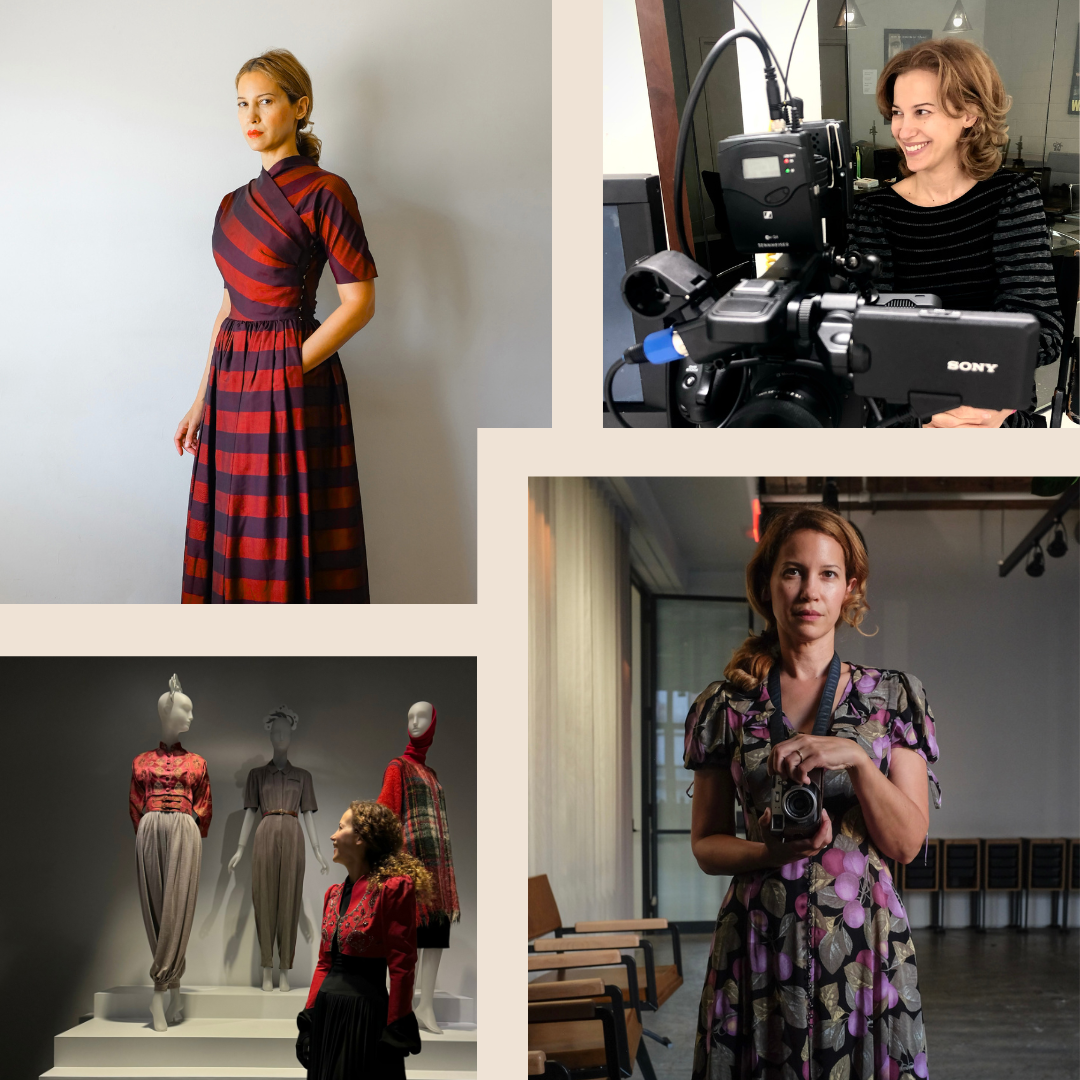
Images (clockwise from top left):
In Claire McCardell c.1955 silk blend hostess gown
On Set, Adri 80s jersey dress, @randytaylorfoto
Davines Group House, Marc Jacobs for Perry Ellis 1992 silk plum print dress
Women Dressing Women Exhibitionat the Metropolitan Museum Costume Institute, left to right: Tina Leser, Vera Maxwell, Bonnie Cashin. On Marie-Claire, 1938 Hattie Carnegie beaded faille bolero and Norma Kamali OMO 90s jersey jumpsuit, photo @randytaylorfoto