Dialogues on Dress: Justine De Young
This month we spoke with Justine De Young, art historian, author, and professor at FIT.
The history of dress and the future of fashion act in dialogue, always interfacing to inform our present moment. The Costume Society of America’s diverse members exemplify this reality like no other; through the constant connections across time and disciplines they draw, our membership of costume curators, designers, artists, and so much more embody fashion’s ubiquitous presence—and dress’s daily power to teach us all something new.
We hope you will join us for CSA’s new Dialogues on Dress series, interviews now available monthly in our e-News and here on our website.
Interested in getting in touch? Email enews@costumesocietyamerica.com
Dialogues on Dress: Justine De Young
An art historian, author, and professor at FIT, Justine De Young is on a mission: opening the eyes of the art world to fashion as fundamental. Whether writing about the 19th century in her latest publication, The Art of Parisian Chic, researching art & fashion spanning centuries as the Founder and Editor-in-Chief of FIT’s renowned Fashion History Timeline, or teaching courses in ethical and contemporary issues in fashion at FIT, Justine is constantly connecting art & fashion discourses. Justine was part of the faculty of the Harvard College Writing Program and taught fashion history as a visiting professor at Wellesley. She is a prolific published writer and long-time CSA member. In short, she’s spent years immersed in the world of dress and art history, and knows just how expansive these disciplines and their impact truly are. At its heart, her work is all about broadening our conversations, bringing it all into the dialogue–whether that is moving “beyond European brands only getting in trouble for appropriating the cultural heritage of another group, toward a more widespread recognition of and appreciation for that heritage,” showing the parallels between the 19th century and today, or getting inspiration from a variety of sources, (dance being one of her favorites)!
This interview has been edited and condensed for clarity.
___________________________________________________
Paint a brief sketch of your background, personal and professional. What does your journey prior to arriving at FIT look like?
I think my earliest fashion memories are from growing up in Savannah, Georgia. I saw a lot of Civil War reenactors in period dress, and I think that seared itself onto my imagination a little bit. I grew up loving Impressionist paintings—Monet, Renoir—and having pictures of pretty dresses on my walls. A particular passion for the 19th century also grew out of my love for Edith Wharton novels. I read them all in high school and she remains one of my favorite authors today. She’s so modern and frank in her writing it collapses all sense of historical distance (at least for me).
I never really considered going into fashion or art as a high school student because I didn't know those were options. It wasn't until I went to Williams College that I took an introductory art history class on a whim. I had always planned to study abroad in Paris, and while I was there, I took so many art history classes that I ultimately declared a double major in art history and English.
When I was deciding where to go to graduate school, I realized my heart was more with art history. I ended up at Northwestern in Chicago, which had three 19th-century specialists at the time. My interest in women, dress, and fashion really flourished there, particularly through the study of painting and modern life. My dissertation focused on images of women in black, which led me to think very seriously about the role of fashion in paintings. I kept encountering art historians describing women as "fashionably dressed" without providing any evidence that the clothes were actually fashionable. So, I started looking more closely at fashion plates, fashion trends, and contemporary responses to the paintings. Again and again, I found that the fashion was actually fundamental to understanding the work.
That became part of the impetus for my most recent book. I wanted to make people take fashion seriously and recognize that it's fundamental to understanding what these paintings meant at the time. Fashion wasn't simply something the women happened to be wearing; it was foundational to the concerns of the artists themselves, and I think taking it seriously can reshape the narratives around 19th-century art.
~ Fashion wasn't simply something the women happened to be wearing; it was foundational to the concerns of the artists themselves, and I think taking it seriously can reshape the narratives around 19th-century art. ~
I would love to hear how you would characterize your relationship to dress over the years. How has fashion influenced your personal journey and identity?
Growing up in the South, there's inherently a very formal way of dressing. I was very much a girly girl. Growing up in the '90s, I loved short skirts and minimalism, and I was very interested in actresses like Gwyneth Paltrow. I loved the casual elegance of her style, and she was probably my gateway into thinking more about fashion. It was always aspirational, though. I wasn't wearing designer clothes. As I've gotten older, I've realized that while I have a personal style, I'm not someone who chases trends. I tend to wear the same pieces. I have things in my closet that are 15 years old, and I try to find things that I really like and that flatter me and then keep wearing them until they need to be repaired. I'm definitely on the more sustainable side. I try to buy only one or two things a year, if that.
It's actually being at FIT that has made me much more fashion-conscious. My students are very interested in contemporary fashion, and I teach classes that engage with contemporary issues, so I have to stay much more aware of trends and conversations within the industry than I did when I was teaching elsewhere.
I still really love 19th-century fashion, but I don't wear it myself. I love researching it and think it's beautiful, but my own style is probably fairly professorial and very '90s-influenced. I'm not a huge fashionista.
~ I also encourage graduate students not to assume that they can't be professors. I was convinced that I was too nervous to teach, that I needed to work behind the scenes. But as you gain age and experience, teaching becomes easier. I still get nervous at the beginning of every semester, but I love it. ~
Tell me about your journey into teaching and becoming a professor. How did you know that was the sort of work you wanted to pursue within art history and dress?
When I was deciding between graduate school in English [Justine’s undergraduate degree] and art history, what tipped me toward art history was the opportunity to both teach and potentially curate. I really liked the public-facing component of art and fashion history. When I went into graduate school, I actually thought I was going to be a curator. I kept applying for jobs in both realms, but the stars just never aligned for curatorial work. But I see now that it really worked out. FIT is a perfect fit for my interests in both art and fashion, and I've loved being in New York and teaching there.
I also encourage graduate students not to assume that they can't be professors. I was convinced that I was too nervous to teach, that I needed to work behind the scenes. But as you gain age and experience, teaching becomes easier. I still get nervous at the beginning of every semester, but I love it. Especially at FIT, it's rewarding to see how students interpret what we talk about through their own disciplines and creative work.
What are some of your favorite courses to teach, and what do you find students today most inspired by or excited about?
I've created two classes at FIT that take a more global approach: one is a global fashion history class, and the other is an introductory fashion history course structured around global case studies. My students are really interested in being part of the global fashion world while also being ethical about their engagement with it. We see so many missteps from even major brands, and I think students genuinely want to make a difference, which I find inspiring.
They all have very particular interests, so I also end up learning a lot through their research and the things they want to tell me about—whether it's 19th-century Georgian dress, traditional costume, or a new designer working in South Africa.
One of the things I've especially enjoyed about teaching at FIT is the opportunity to connect historical material with contemporary questions. I teach an introductory fashion history course that focuses on ethics and contemporary issues, so we're always discussing things that have appeared in the headlines alongside the deeper historical content.
~ My students are really interested in being part of the global fashion world while also being ethical about their engagement with it. We see so many missteps from even major brands, and I think students genuinely want to make a difference, which I find inspiring. ~
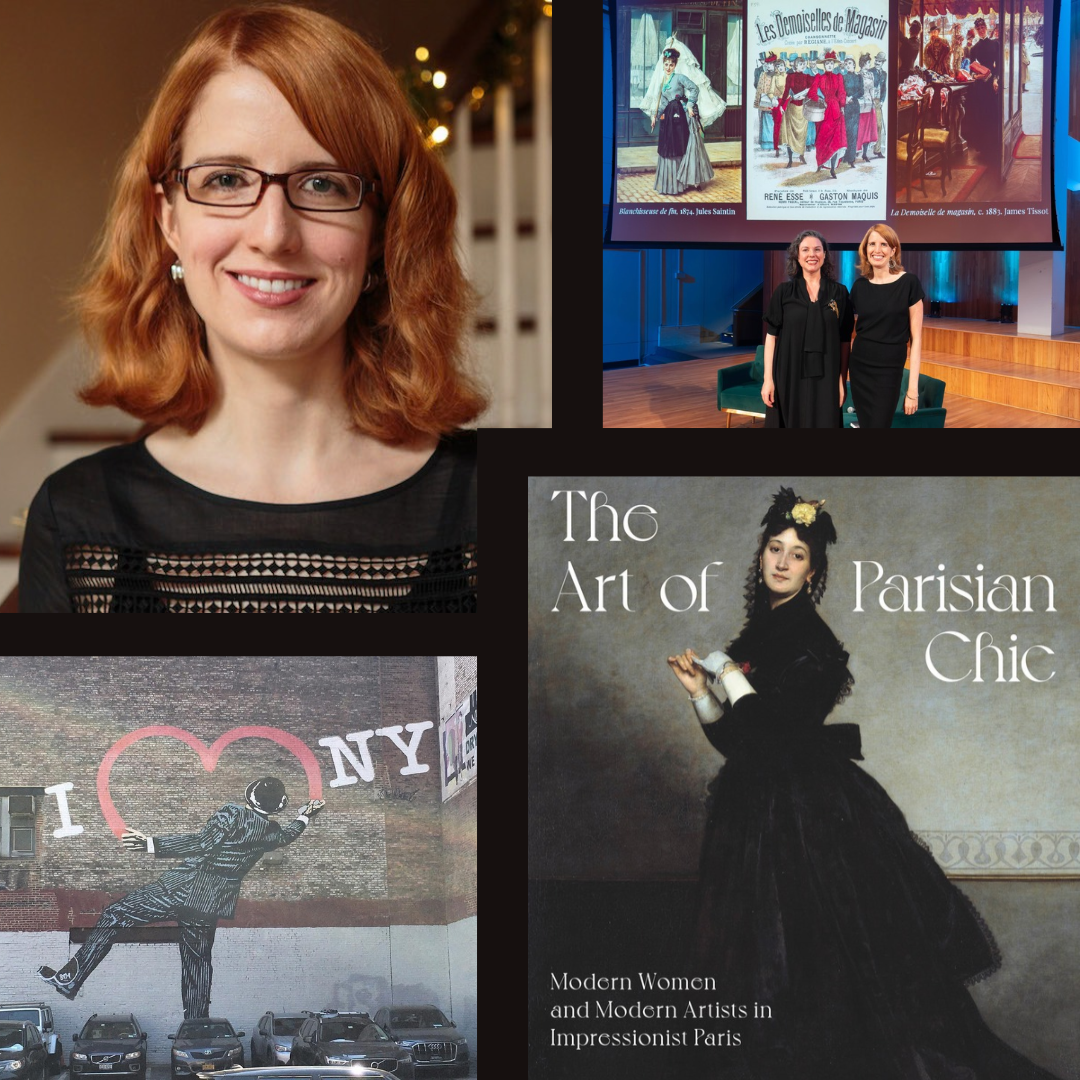
How do you balance teaching and writing? I’d also love to hear a bit more about your book [The Art of Parisian Chic: Modern Women and Modern Artists in Impressionist Paris].
It certainly is a challenge. At FIT this semester, I'm actually teaching four different classes. So that does take up a lot of time. I have to just be very intentional about things and obviously really take advantage of the breaks between semesters when I fortunately don't have to teach. So, I do a lot of work in January and then in the summer months.
I also use conferences to really force myself into some writing. I’ll submit an abstract or conference paper, then I know that I have to do that research. That is a way of keeping myself accountable, because I can go down rabbit holes and find myself doing research that doesn't have a particular goal. Honestly, it's not a great work-life balance. I do sometimes have to work on the weekend, but I'm such a nerd that I do really enjoy my research. I am conscious of the need to take breaks. But thankfully, New York has many distractions. So, we can always go see an exhibition, even if it's only for part of an afternoon.
One thing that really struck me while writing my book were the parallels between the culture of social media, influencers, and self-fashioning that we live in today and in the 19th century. I found it really inspiring to discover the stories of real women and how they coped with this new level of scrutiny, as well as the ways stereotypes and stereotypical expectations shaped how they perceived others and how they themselves were perceived. That was an important through line for the book, in addition to looking at how artists and women crafted their reputations through clothes. The parallels between the 19th century and our own moment were really striking to me as I was writing, and I hope they remain interesting to readers today.
~ One thing that really struck me while writing my book were the parallels between the culture of social media, influencers, and self-fashioning that we live in today and in the 19th century. I found it really inspiring to discover the stories of real women and how they coped with this new level of scrutiny, as well as the ways stereotypes and stereotypical expectations shaped how they perceived others and how they themselves were perceived. ~
Describe a typical day of work or studies—and perhaps some leisure—or, if no day looks the same, describe a good one. Where are some of your favorite places in NYC?
In terms of non-teaching time, I try to get as much writing done as possible during the summer and in January. I was very fortunate to have a year-long sabbatical, which was transformative. That's when the bulk of my most recent book was written. I spent that sabbatical in New York rather than traveling, because I wanted to stay focused on the research and writing.
When I need to recharge, museums are an obvious answer. I love the Met, which I knew particularly well after spending a year as a fellow at the Costume Institute. There's always a new exhibition to see, and they're consistently interesting and well done. Of course, I also find the Museum at FIT very inspiring.
I get a lot of inspiration from dance. I love contemporary dance and ballet. It isn't necessarily directly related to my work, but I find it relaxing and a good way to focus on something other than being inside my head. We’re subscribers at the Joyce Theater, and we also go to New York City Ballet and American Ballet Theatre, although only a few times a year because they're expensive. Fall for Dance at City Center is another great option because it makes dance much more accessible.
For someone who wants to start exploring dress through the lens of art history—as a non-student—what suggestions might you have? Podcasts, books, etc.? I really enjoyed Seeing Through Clothes by Anne Hollander.
I think there are so many avenues into researching fashion and art history. I created the Fashion History Timeline website partly to help art historians realize that it's not actually that difficult to do fashion research. The site has expert-written reviews of fashion by decade and cites its sources. So, if you're interested in a particular period—for example, the 1670s—you can start with the relevant page and then follow the sources that the author found most useful. We've also tried to link to online resources and make it a clearinghouse for ways of doing research.
There are books that I recommend, although I think the list of books specifically about fashion and art history is somewhat limited. Seeing Through Clothes by Anne Hollander is certainly one way into the subject. I also think my own book can be useful for a general audience; my goal was really to demystify fashion in art.
Fashion-related art history exhibition catalogues are another excellent place to start. I was involved in the Impressionism, Fashion, and Modernity catalogue from 2012–2013, which is still a solid entry point for the 19th century. More broadly, there have now been fashion-related exhibitions covering many different periods, and their catalogues can point you toward additional scholarship. If you want to go deep on a particular topic, that's a very good way in.
~ I think the conversations we have about fashion are still more limited than they need to be, even as the world itself becomes increasingly global. ~
What does the future of fashion look like to you?
I really hope there is growing awareness of the fashion histories of peoples and cultures outside of Europe. That's already happening within fashion history, but I don't think popular culture has quite caught up yet. A lot of my efforts in recent years have been focused on expanding awareness of the rich and deep fashion cultures around the world. I think the conversations we have about fashion are still more limited than they need to be, even as the world itself becomes increasingly global. I hope that the conversation can move beyond European brands only getting in trouble for appropriating the cultural heritage of another group, toward a more widespread recognition of and appreciation for that heritage.
I also hope the industry takes sustainability seriously. The tremendous rise of fast fashion over the course of my lifetime has been disturbing to me, particularly because of the amount of waste. I'm still wearing clothes from 15 years ago, but I don't think my students will necessarily be able to say the same thing in 15 years. I hope European regulations will help rein that in, because it's clear that companies haven't been willing to regulate themselves sufficiently. Ultimately, I'd like to see a more global and more sustainable approach to fashion.
And I also wonder whether, in this moment of AI-generated content, there might be a renaissance of interest in and appreciation for human-made garments and art. I can only hope to have as much optimism as my students do.
___________________________________________________
Thank you so much to Justine for having this conversation with me! You can find her
here, and get her most recent book
here.
~Madison Brito Taylor
Images courtesy of Justine De Young