Dialogues on Dress: Xiaoye Du
This month we spoke with Xiaoye Du, fashion historian, language teacher, and current FIT student.
The history of dress and the future of fashion act in dialogue, always interfacing to inform our present moment. The Costume Society of America’s diverse members exemplify this reality like no other; through the constant connections across time and disciplines they draw, our membership of costume curators, designers, artists, and so much more embody fashion’s ubiquitous presence—and dress’s daily power to teach us all something new.
We hope you will join us for CSA’s new Dialogues on Dress series, interviews now available monthly in our e-News and here on our website.
Interested in getting in touch? Email enews@costumesocietyamerica.com
Dialogues on Dress: Justine De Young
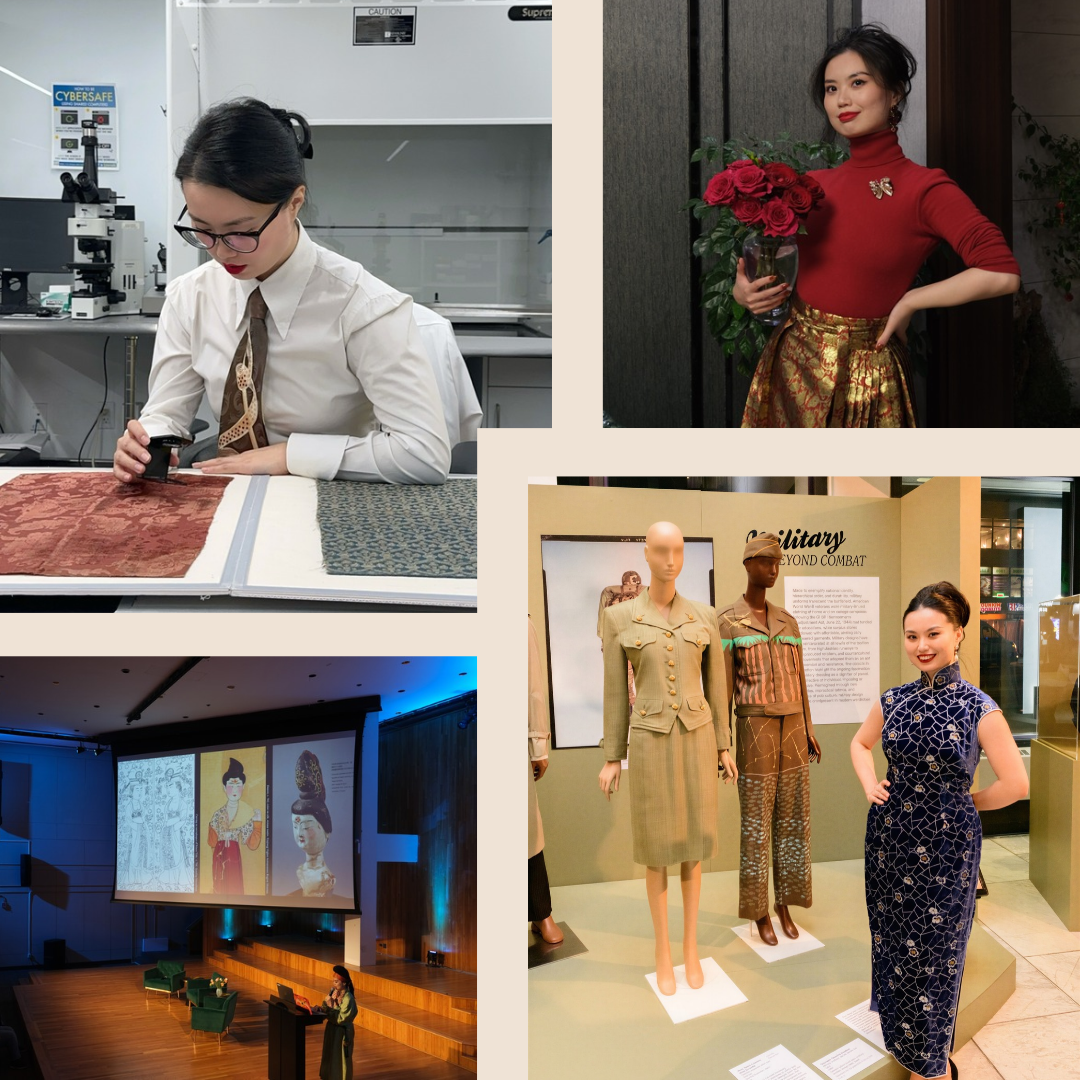
Xiaoye Du considers it an innate responsibility to rewrite biased fashion narratives, imbue the dialogue with historical accuracy, and get others excited about the power of dress–whether that’s featured in Vogue discussing qipao wearing or Chinese make-up or using her own social media platform. Xiaoye’s knowledge and perspective is informed by a multitude of angles. She studied Chinese Linguistics and Literature in Beijing and Applied Linguistics at Columbia University in NYC, and is now a student at FIT’s Fashion and Textile Studies program. She’s part-fashion historian, part-language teacher. In everything, communication is at the core. “If anything, my experience in teaching a foreign language to students from a diverse background anchors my awareness of the challenges that arise in cross-cultural communication,” and that includes the mode of fashion.
This interview has been edited and condensed for clarity.
___________________________________________________
Paint a brief sketch of your background, personal and professional.
I was born and raised in Eastern China (Shandong Province, home of Confucius; or for my fashion and textile folks–it’s also spelled Shantung as in “silk shantung”), and received my bachelor’s degree in Chinese Linguistics and Literature in Beijing. I attended perhaps the most cosmopolitan university in China, where students from quite literally all over the world come together to study Chinese. I am very grateful for this environment where I got to spend four years of my life. I moved to New York City for graduate school [at Columbia], and right now I teach Chinese language to adult learners and research Sino-Western encounters in dress history.
I usually write in my bio that I am a Chinese expatriate who currently lives in NYC. I choose the word “expatriate” with intention, because I have observed the tendency for people I meet in the US to group the international community into domestic demographics such as Chinese or Asian American, or first-generation immigrants. My studies often take me to theories of hybridity and transnationality, but maintaining my conceptual status as an outsider looking in still feels important and has helped me adopt a comparative methodology or mindset in my thinking.
Does a particular memory stand out as foundational to the work you do today, or how did you decide to pursue your current path in fashion?
I have always been interested in dress history for as long as I can remember. One of my earliest memories is sneaking into my parents' bedroom to play (historical) dress-up. They had a silky satin sheet embroidered with phoenix and dragon tucked away in their armoire, presumably from their wedding decor. I loved draping it on myself in front of the mirror and playing make-believe that I was a Tang Dynasty princess–the ample amount of fabric, shiny texture, and soft hand was perfect to fake those voluminous, flowy costumes that I saw in historical dramas on TV. Of course, later in college I would learn that the dominating silhouette for the majority of the Tang Dynasty was much, much slimmer than what I was led to believe, due to the passionate adoption of Central Asian fashions by the Tang people. I learned that in a course I took in college named “History of Sino-Foreign Cross-Cultural Communications.” I was enchanted by the interconnectedness of the pre-modern world; stories such as seventh-century Christians in Xi’an, eleventh-century Arab merchants in Quanzhou, and Jesuit missionaries in the Qing court have since then been central to my studies.
~Growing up in a small town where conformity is encouraged and deviation looked down upon, dressing to stand out was my silent defiance. After moving to the States, especially having experienced American Sinophobia during the pandemic, dressing to say I’m Chinese became important.~
I would love to hear about your personal relationship to style and how that’s evolved over the years. What role has fashion played in developing your sense of identity?
Fashion is my primary non-verbal expression of identity, and my identity has in turn deeply shaped my style. Growing up in a small town where conformity is encouraged and deviation looked down upon, dressing to stand out was my silent defiance. After moving to the States, especially having experienced American Sinophobia during the pandemic, dressing to say I’m Chinese became important. It was also when I started my collection of historic Chinese fashion, especially qipaos, and taking deep dives into the history of fashion.
A welcome side-effect? The traditional two-dimensional cut of Chinese fashion, and the deep-running custom of tailor-made qipaos (as opposed to standardized sizing), freed me from judging my own body from the restraints and standards of contemporary fashion.
~ Before my cohort of Chinese creators and I started posting on English social media, #cheongsam and #qipao was filled with erotic images of Asian women in exotic lingerie. Saddened by what the popular image of this iconic piece of Chinese fashion had become, my initial motivation was just to diversify the social media presentation of the qipao by offering alternative images of historical qipaos being worn. ~
You have a strong following on Instagram—how do you use your social media as a platform to connect and educate?
My Instagram page is based on the strong desire to share and to help shape public perception of the qipao or cheongsam. Before my cohort of Chinese creators and I started posting on English social media, #cheongsam and #qipao was filled with erotic images of Asian women in exotic lingerie. Saddened by what the popular image of this iconic piece of Chinese fashion had become, my initial motivation was just to diversify the social media presentation of the qipao by offering alternative images of historical qipaos being worn. As my platform grew, I started to feel responsible for disseminating correct information, as open sources in the English language were limited and oftentimes biased.
Tell me about your experience at FIT—your focus area, any favorite classes, or what opportunities the school may have opened up for you.
I’ll be graduating this May and am on the Curatorial track. My absolute favorite classes have been the two Western fashion history courses taught by Prof. Lourdes Font! She was the best lecturer I have ever had the pleasure of studying with, always able to deliver thought-provoking and theory-rich but also fascinating histories of what people wore. Some of my research that I’m most proud of began as term papers for her classes, and I am very grateful for her guidance and encouragement. Although it’s a shame that I never had the chance to take her second-year classes such as Fashion Theory, I consider myself lucky enough to be her last graduate class before retirement.
~ I don’t consider my previous academic background separate from my research interest in fashion history, which focuses on cross-cultural encounters in dress. If anything, my experience in teaching a foreign language to students from a diverse background anchors my awareness of the challenges that arise in cross-cultural communication. ~
How did you segue into the fashion field? [Xiaoye went to FIT after an MA in Applied Linguistics at Columbia]
My passion for teaching and language learning has always been about sharing the worldview and experience of another culture. Learning a language is the best device you can ever have. I enjoy bringing my students to the Met; seeing Chinese artifacts in person generates discussion about history and culture that seems vague in the classroom. I don’t consider my previous academic background separate from my research interest in fashion history, which focuses on cross-cultural encounters in dress. If anything, my experience in teaching a foreign language to students from a diverse background anchors my awareness of the challenges that arise in cross-cultural communication.
Over the next five years, how do you see your work evolving? Tell me about a dream project, a vision, or general directional mood…
I hope to continue my research and be able to dedicate my time to what I love and have interest in, if possible towards a doctoral degree. A dream project would be to build a visual Chinese fashion archive on social media that provides an outlet for the less represented voice of Chinese fashion history.
What does the future of fashion look like to you?
I rI think less about the future of fashion than about the history of fashion. Whatever the future looks like, I believe we can only form any idea of it by looking at the past.
___________________________________________________
Thank you so much to Xiaoye Du for having this conversation with me. You can learn more about her work and follow her
here!
~Madison Brito Taylor
Second image, clockwise from top right: Photo by Cat Trzaskowski