Dialogues on Dress: Nic Cherry
This month we spoke with Nic Cherry, Director at Barrett Barrera Projects, an independent exhibition provider of fashion, contemporary art, and visual culture.
The history of dress and the future of fashion act in dialogue, always interfacing to inform our present moment. The Costume Society of America’s diverse members exemplify this reality like no other; through the constant connections across time and disciplines they draw, our membership of costume curators, designers, artists, and so much more embody fashion’s ubiquitous presence—and dress’s daily power to teach us all something new.
We hope you will join us for CSA’s new Dialogues on Dress series, interviews now available monthly in our e-News and here on our website.
Interested in getting in touch? Email enews@costumesocietyamerica.com
Dialogues on Dress: Nic Cherry
Barrett Barrera Projects (BBP) is a powerhouse in the dress space, operating at the nexus of fashion, contemporary art, and visual culture to bring independent exhibitions into museums from top-to-bottom–including development and touring, collection strategy, fashion mounting, installation support, and project management. It manages all of this in addition to its many other branches, like hospitality work, consulting, and chiefly, collections management (one of which happens to include the largest private holding of Alexander McQueen pieces). It is no surprise that a leader of such an operation thrives in environments of dynamism and diversity. Nic Cherry, Director at BBP, finds himself using a power saw one minute and hopping on a logistics video call the next; he wouldn’t have it any other way. With a background in theater direction and design, Nic is particularly adept at translating ideas into visual space, at highlighting how fashion and the feelings it evokes are never neutral. The way a piece is mounted or a space is configured creates “experiences with distinct emotional and narrative identities,” and Nic carries that knowledge through his work and beyond. Whether discussing “overconsumption disguised as self-expression,” custom-designing and building a home with his husband, or BBP’s particularly notable exhibition work, his voice is rife with an excitement and acuity that makes you want to think just a bit harder about how you get dressed in the morning, or how you yourself step into a space.
This interview has been edited and condensed for clarity.
___________________________________________________
Please paint a sketch of your background, personal & professional. What does your journey prior to arriving at Barrett Barrera look like?
I trained in theater directing and design, worked in scenic and costume shops, and spent years designing scenery, lighting, sound, and costumes before moving into arts management in the nonprofit public art sector.
After nearly a decade in public art, I joined a company that managed one of the world’s largest portfolios of traveling museum exhibitions. That job took me around the world, installing exhibitions in a wide range of museums and cultural institutions. Through that work, I connected with Barrett Barrera Projects (BBP), which brought me to St. Louis to help manage its new spaces and strengthen its museum exhibition program.
At BBP, the different strands of my background came together: the spatial and technical thinking of theater, years of arts management, museum work, and my interest in fashion.
What has your relationship to fashion looked like over the years? What role has fashion played in developing your sense of identity?
Working in theater, I loved how costume design could communicate the inner life of a character and the fullness of their identity before they ever spoke.
The theatricality of Alexander McQueen’s runway presentations first drew me into the wider world of fashion. His shows reached far beyond the runway and entered the broader cultural lexicon. His design language and use of narrative became deeply embedded in me, revealing how immediately a single designer could influence the way an entire culture sees and expresses itself. McQueen became my personal conduit into fashion as a serious creative discipline, and I have never stopped watching runway presentations.
Later, when I was traveling for work nearly 90 percent of the time, my relationship to clothing became intensely practical. I began carefully crafting the perfect capsule wardrobe. Living out of a suitcase teaches you very quickly what matters. Every detail counts.
Now that I am settled in St. Louis and working for a creative company, I dress much more expressively, though I know I will never outshine the objects in our collection that I have the privilege of working among every day.
~ I was drawn to BBP because I was impressed by the ambition of its programming. For such a compact company, it was doing an astonishing amount: gallery exhibitions, artist collaborations, museum projects, public programs, and unusual experiments in hospitality and presentation. Its willingness to move between disciplines and formats felt closely aligned with my own background. ~
What drew you to working at Barrett Barrera, and how has the company evolved in your time there? For those unfamiliar, what exactly is Barrett Barrera?
Barrett Barrera Projects is an independent exhibition provider specializing in the curation, production, and touring of cross-disciplinary exhibitions at the intersection of fashion, contemporary art, and visual culture. We work with museums, artists, collectors, and cultural organizations on exhibition development and touring, collection strategy, fashion mounting, installation support, and project management.
BBP also manages an extensive collection of fashion, fine art, and photography that supports our exhibitions, institutional loans, and collection-based projects. It includes contemporary art, the Ann Ray photographic archive of Lee Alexander McQueen imagery, and a major fashion archive containing the largest private holding of Alexander McQueen works.
I was drawn to BBP because I was impressed by the ambition of its programming. For such a compact company, it was doing an astonishing amount: gallery exhibitions, artist collaborations, museum projects, public programs, and unusual experiments in hospitality and presentation. Its willingness to move between disciplines and formats felt closely aligned with my own background.
When I arrived, BBP had just opened a new exhibition space and headquarters, launched the visionary hospitality project Barrett Barrera Guest House, and was continuing to operate its longstanding commercial gallery, projects+gallery.
Over the past five years, the company has changed considerably. Building on the success of our museum exhibitions, and responding to broader cultural and economic changes, we closed the commercial gallery and concentrated our work around collections management, institutional partnerships and loans, strategic consulting, and the production and touring of exhibitions at the intersection of fashion and contemporary art.
I have helped build the systems behind that shift. We have expanded the touring program, strengthened the way we manage our collections and exhibitions, and developed a clearer, more focused model for bringing ambitious fashion exhibitions to museums.
Describe a typical day of work, or if no day looks the same, describe a good one.
I have always chosen to work at small, entrepreneurial organizations where creative thinking and the physical production of projects happen side by side. Throughout my career, I have moved between development, design, logistics, making, and hands-on production. I love the mix, and no two days are quite the same.
One day last week captured it particularly well. I spent the morning finalizing transportation logistics for a museum loan traveling to Australia. From there, I shifted to refining layout details in SketchUp for our Statement Pieces exhibition, opening this fall at the Kalamazoo Institute of Arts. I then joined a video call with a museum partner to review installation schedules and logistics.
In the afternoon, I moved into studio mode and used a power saw to reduce the size of a mannequin. In the middle of that, a shipment of new crates arrived, so we hauled those off the truck. After cleaning the workspace, I test-fitted a beautiful strapless Richard Quinn dress onto the newly reduced mannequin. Once it is properly fitted, I will spend several days repairing damage to the interior structure and shape of its skirt flounces.
Logistics, big-picture planning, partner communication, power tools, and minute details, all in one day. Most days lean more heavily toward one discipline or another, but I love the balance and the way the different parts of the work inform one another.
That interest in places where disciplines merge also carries into my life outside work. My husband and I custom-designed and built the home we share with our much-adored dogs, carrying the process from architecture and construction through the interiors, art, objects, and landscape. We continue to treat it as an evolving collaboration between design and daily life.
I also spend as much time as I can outdoors, particularly near rivers, hiking, kayaking, or simply being in the landscape. That time gives me a different kind of spatial awareness, shaped by season, movement, weather, material, and scale. It is also one of the few places where I am not necessarily trying to produce anything, allowing instead for a kind of contemplative communion with the natural world.
This past year, we created
The Turning, an eight-part dinner series in which we prepared eight courses for eight guests, with each menu built around seasonality and storytelling. It brought together food, design, hospitality, ritual, performance, and connection. Whether at work or at home, I am happiest when different forms of creativity come together to make something larger than any one discipline.
Tell me about some recent BBP projects, or anything you are particularly proud of.
When BBP learned about A Match Made in Heaven: Katherine Bernhardt x Jeremy Scott, curated by JoAnne Northrup for the Nerman Museum of Contemporary Art, we had to see it for ourselves. The exhibition brings together internationally renowned Kansas City native Jeremy Scott and St. Louis native Katherine Bernhardt, placing Scott’s fashion alongside Bernhardt’s paintings and revealing the visual languages they share.
We immediately knew it needed a life beyond its premiere at the Nerman. My current work is figuring out how to turn a one-time project, which originally required weeks of installation and a significant institutional lift, into a nimble touring exhibition. At the same time, I am preparing the materials needed to introduce it to future museum partners.
The goal is to create a version that can install in two weeks, is manageable and enjoyable for museum partners to present, and still retains the magic, energy, and feeling of the original. That is my happy place.
It has also been a privilege and a joy to work directly with Jeremy’s extraordinary archive. I am pre-fitting garments to mannequins and developing mounting and packing systems that will allow the works to ship compactly and safely, then be dressed efficiently and securely at each venue. I love moving between the larger touring strategy and the minute physical details that make the exhibition possible.
I cannot wait to bring the exhibition to new museums and new audiences. If you think A Match Made in Heaven could be a good fit for your institution, we would be delighted to hear from you...
~ At its best, fashion is a form of cultural commentary in its own right. That makes sense to me given my background in theater, where artists bring space, body, and time together, and in public art, where artists work with public space, people, and civic life. Fashion can combine sculpture, architecture, performance, photography, craft, theater, music, and technology while remaining uniquely connected to the body and to how people construct and communicate identity. ~
As Barrett Barrera works at the intersection of fashion and other art forms, can you say more about how these different areas overlap?
I am drawn to objects made by designers and houses that pull from personal history, technical knowledge, material research, and fully developed creative worlds to make work that will endure. I am equally drawn to contemporary artists whose practices are rooted in those same kinds of investigation.
At its best, fashion is a form of cultural commentary in its own right. That makes sense to me given my background in theater, where artists bring space, body, and time together, and in public art, where artists work with public space, people, and civic life. Fashion can combine sculpture, architecture, performance, photography, craft, theater, music, and technology while remaining uniquely connected to the body and to how people construct and communicate identity. That intersection is where much of BBP’s work lives.
You can see it across our exhibitions and collections. Designers including Rei Kawakubo, Alexander McQueen, Iris van Herpen, Vivienne Westwood, and Jordan Askill approach fashion through experimentation, storytelling, and material research. Artists in BBP’s contemporary art collection, including Marilyn Minter, Hassan Hajjaj, Nick Cave, Hank Willis Thomas, Kehinde Wiley, and James Turrell, explore many of the same questions through identity, cultural history, material, space, and perception.
BBP works with designers, artists, photographers, archives, collectors, and museums. We try to preserve the energy that makes fashion so captivating while giving people time to look more closely. We are interested in work that rewards a second and third look, and that remains alive long after its original moment.
Over the next five years, how do you see your work evolving? Tell me about a dream project, a vision, or general directional mood.
I want to keep growing BBP’s touring exhibition program and continue exploring what exhibition design can do to shape the physical visitor experience.
Exhibition design is one of the parts of my work I love most. The way a visitor encounters a garment is never neutral. Scale, sequence, sightlines, lighting, sound, and movement through a gallery all affect how an object is understood. Museums can do much more than place beautiful objects in a room. They can create experiences with distinct emotional and narrative identities.
Our exhibitions show how different those identities can be. Lee Alexander McQueen & Ann Ray: Rendez-Vous [which received CSA’s Richard Martin Award in 2024] is serious and contemplative. It asks visitors to slow down, look closely, and consider an intimate creative relationship, ultimately ending on a heavy emotional note. A Match Made in Heaven: Katherine Bernhardt x Jeremy Scott, by contrast, is full of joy, color, humor, and energy. Both are fashion exhibitions, but their curatorial and spatial languages create completely different experiences.
To me, that is not far from theater. Space carries narrative. It establishes rhythm, directs attention, builds anticipation, and determines what is revealed and when. I approach exhibitions in much the same way, particularly with fashion, where the body is absent but still strongly implied. Design can restore a sense of movement and presence while establishing the mood through which visitors encounter the work
Fashion exhibitions can be enormously complex and resource-intensive. Our job is to absorb and organize much of that complexity so museum teams can focus on presenting the work. We aim to be responsive, collaborative partners who make the process not only achievable, but genuinely enjoyable. The work is serious, but working with us should also be fun.
~ Exhibition design is one of the parts of my work I love most. The way a visitor encounters a garment is never neutral. Scale, sequence, sightlines, lighting, sound, and movement through a gallery all affect how an object is understood. Museums can do much more than place beautiful objects in a room. They can create experiences with distinct emotional and narrative identities. ~
What does the future of fashion look like to you?
Right now, fashion often feels split between two extremes. At one end are extraordinary levels of craft, legacy, exclusivity, and price. At the other is clothing made to be inexpensive, rapidly consumed, and quickly discarded. That divide reflects broader economic inequalities and leaves fewer options between luxury and disposability.
What seems to be disappearing is the space between those extremes: thoughtfully designed, well-made clothing that more people can afford. I want the middle back.
Even within the low and middle ranges of the market, price is no longer a reliable indicator of quality. Consumers have to be remarkably educated to know whether they are receiving value. I hope quality material and durable construction become easier to recognize and more widely accessible, rather than placing the burden entirely on individual shoppers.
I also hope we move away from overconsumption disguised as self-expression. I am much more interested in smaller wardrobes built slowly and intentionally, with pieces that carry the inspiration and creativity of a strong designer, communicate a point of view as clearly as art, and remain wearable and built to endure.
And wear the fun things. Do not save the “good stuff” for an event that may never come. I am trying to take my own advice on that one. Clothing becomes meaningful through use. The best pieces should be lived in, cared for, grown with, and returned to over time.
___________________________________________________
Thank you so much to Nic Cherry for having this conversation with me! You can learn more about BBP here and follow their work here.
~Madison Brito Taylor
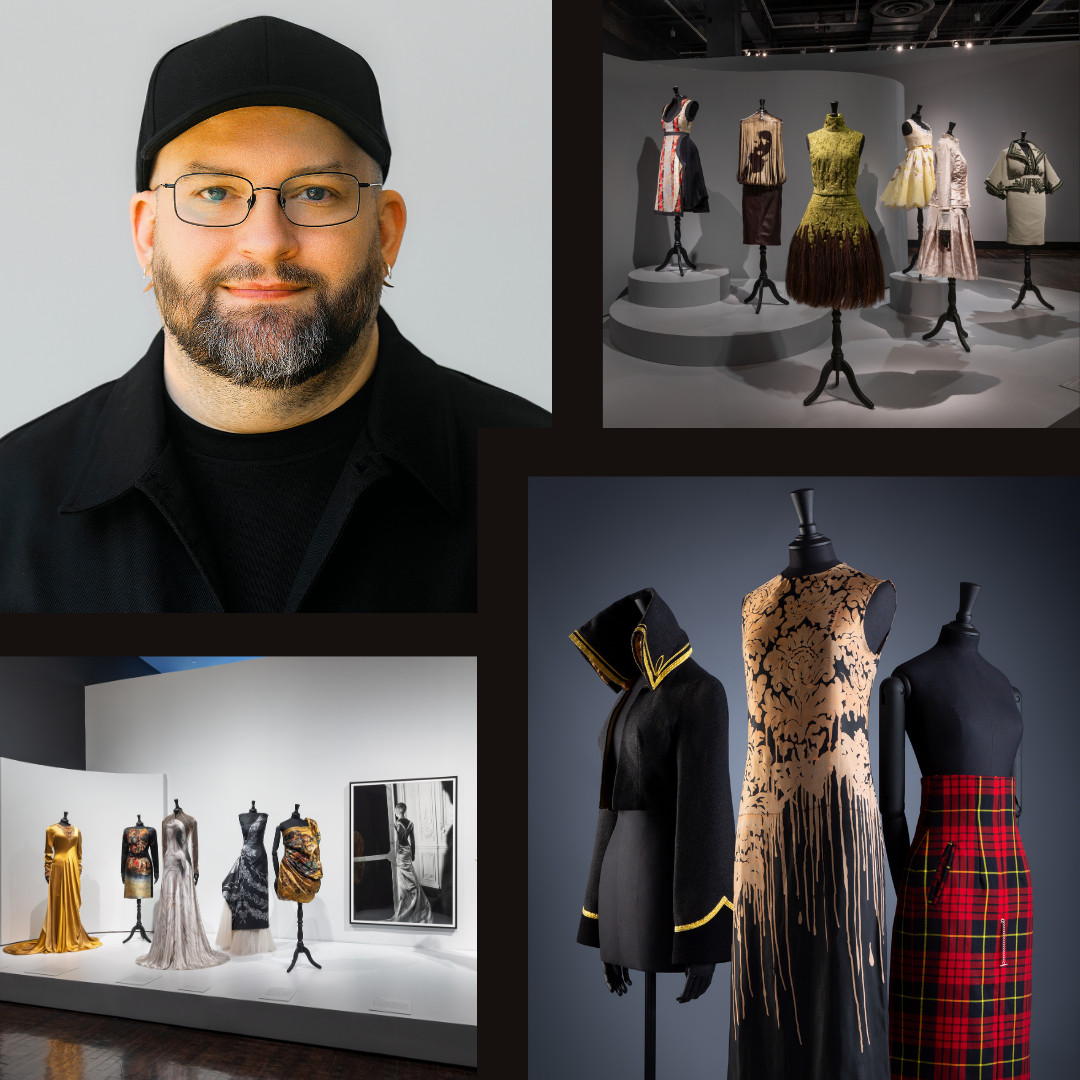
Images clockwise from top left:
- Nic Cherry, photo by Attilio D’Agostino
- Lee Alexander McQueen & Ann Ray: Rendez-Vous installation, Frist Art Museum, 2024. Photo by John Schweikert
- Alexander McQueen, cropped military-style jacket, William Morris print dress, and calf-length McQueen tartan skirt with watch chain by Shaun Leane, Banshee, Autumn/Winter 1994 and Highland Rape, Autumn/Winter 1995. Photo by Nic Cherry for Barrett Barrera Projects
- Lee Alexander McQueen & Ann Ray: Rendez-Vous
installation, Frist Art Museum, 2024. Photo by John Schweikert