Dialogues on Dress: Ben Barry
Check out our latest interview with Ben Barry, Dean of Parsons School of Design.
The history of dress and the future of fashion act in dialogue, always interfacing to inform our present moment. The Costume Society of America’s diverse members exemplify this reality like no other; through the constant connections across time and disciplines they draw, our membership of costume curators, designers, artists, and so much more embody fashion’s ubiquitous presence - and dress’s daily power to teach us all something new.
We hope you will join us for CSA’s new Dialogues on Dress series, interviews now available monthly in our e-News and here on our website.
Interested in getting in touch? Email enews@costumesocietyamerica.com
Dialogues on Dress: Ben Barry
Representation and access within the world of fashion have been top of mind for Ben Barry from some of his earliest memories. As the Dean of Parsons, his mindset operates around continuously creating a just and more “inclusive and imaginative field,” a framework bolstered by years of running his own modeling agency—its beginning dating back to the tender age of fourteen—and at Cambridge University pursuing his PhD, to recent years rewiring Parsons curriculum and climate for deep and lasting institutional change; a kind of progress that honors the impact and possibilities of fashion to both “teach us how to survive in the world as it is, but also how to imagine the world as it could be.” Ben’s voice in the field is simultaneously steady and inspiring, a galvanizing force for thoughtful change, nuanced vision, and genuine joy. Below, he shares reflections on the Parsons Disabled Fashion Student Program, new courses, and expanded faculty that has broadened Parsons’ representation and range of “fashion expertise and lived experiences,” to thoughts on dress as a multisensory medium, the joy of wearing student designs, and where to find the best gluten-free baked goods in the city…
Read the interview below.
___________________________________________________
Please paint a brief sketch of your background, personal & professional. What did your journey prior to arriving at Parsons entail?
I’d describe myself as a white, queer, Disabled fashion educator, designer-researcher, and academic leader who is wholeheartedly committed to advancing justice through and within fashion. I’m the Dean of the School of Fashion at Parsons School of Design in New York City, where I’m also a tenured faculty member and hold the Gromek Endowed Professorship in Fashion Business. I joined Parsons in 2021, arriving from Toronto Metropolitan University. I started my academic career in their Fashion department as an Assistant Professor of Equity, Diversity, and Inclusion and was the Chair from 2018-2021.
I have taught courses across fashion studies, management, and design that support students in developing critical frameworks and practices to advance a more inclusive and imaginative field. My current research uses a range of methodologies, from surveys and interviews to the co-creation of fashion shows and exhibitions, to explore how Disabled people produce, navigate and reimagine disability and fashion. I am also co-leading a network that is exploring the peer-review process of practice-based fashion research, which will ultimately develop a framework that can be used by galleries, journals, and committees.
~Fashion and dress studies is serious work. It’s about politics, histories, cultures, power, emotions, and economies. But at its heart, it is about the joy of self-expression, connection, and creation.~
Does a particular memory stand out to you as being foundational to your interest within fashion today??
As a kid, my fun didn’t come from playing basketball or hockey. It came from playing in my grandmother’s closet and turning her hallway into a runway. As my vision changed, my relationship to fashion has also become about the possibilities of fashion to create access. For example, I often wear bright, bold colors so that if I can’t always see what’s coming, I’ll be seen.
For me, fashion teaches us how to survive in the world as it is, but also how to imagine the world as it could be. That’s the heart of my relationship with fashion. But I also know that for many people, that kind of relationship with fashion isn’t possible because the industry has been so exclusive. Clothes don’t fit all bodies, making clothes can be out of reach, and fashion sends the message that many of us don’t belong.
~I found that when consumers saw models who reflected them, brand loyalty and purchase intention actually increased. But the bigger insight was that this idea of aspiration wasn’t about a specific body but about the creativity, artistry, and glamour of the clothes, hair, make-up, and art direction. Aspiration could be applied to any body by designers and creatives. It just typically hadn’t been.~
How did you arrive at academia? What drew you to universities?
I have to take you back to when I was fourteen. One of my friends had taken a modeling course and was told she was “too big” to be a model unless she lost weight. That made no sense to me. So I took her photos and sent them to a local magazine in my hometown of Ottawa, Canada. I included a note asking if the fashion editor wanted to hire her and included my name and phone number. A few weeks later, the editor called, said the magazine wanted to hire my friend for a photo shoot, and she assumed I was her agent. That one phone call launched my modelling agency, the Ben Barry Agency. From the start, I focused on representing fashion models who weren’t being represented by other agencies, people of different sizes, races, ages, and disabilities. I ran my agency from fourteen until I finished my PhD.
That work inspired me to go to university. I wanted to understand the business of fashion, its history of representation, and its social impact. I completed my PhD in Management at Cambridge University because a key question kept coming up in my business was why were my models getting hired by commercial fashion brands but not high-fashion labels. Designers and photographers would tell me that my models weren’t “aspirational” enough to sell luxury fashion. So my doctoral research tested that claim. I studied how models of different sizes, races, and ages influenced consumers’ perceptions of high-fashion brands. I found that when consumers saw models who reflected them, brand loyalty and purchase intention actually increased. But the bigger insight was that this idea of aspiration wasn’t about a specific body but about the creativity, artistry, and glamour of the clothes, hair, make-up, and art direction. Aspiration could be applied to any body by designers and creatives. It just typically hadn’t been.
That realization shifted my career focus. To truly create a more inclusive fashion industry, I needed to help influence how the next generation of fashion designers, creatives and professionals understood beauty and represented it through fashion.
~I’m very conscious of my positionality, and of the privilege that comes with being seen and heard in particular ways in leadership and academic spaces. Wearing creative student designs allows me to challenge some of the expectations about professional dress, gender, and power that come with that. I often wear clothes that push against those norms and hopefully open up spaces for others to do the same.~
Please describe a typical day of work and perhaps some leisure. If no day looks the same, describe a good one. Do you have any favorite spots around New York?
I’m usually up around six. I’ll make a coffee and try to get in about an hour or two of research and writing. After that, my husband and I will take our dog, Apple, for a walk through Greenwich Village. It’s one of my favorite parts of the day. Once I’m home, I’ll have breakfast, do some deep work, get ready, and walk to campus. If it’s a Wednesday, I’ll often pop by the Union Square Farmer’s Market. There’s an incredible gluten-free bakery stand called Knead Love that makes the best bagels and muffins. As a celiac, it's a dream!
Afternoons are usually packed full with meetings. These include spending time with faculty, staff, students, other deans, committees, or external partners. If I’m teaching that semester, I’ll often have class too. Most days wrap up around six, unless there’s a student showcase, a guest lecture, or an event on campus. Then I head home, walk Apple again with my husband, and we’ll make dinner together. After dinner, I head to the gym, take a bath, write down everything on my mind that’s keeping me up, and watch something on Netflix or scroll on TikTok before bed.
I’ve read a bit about curriculum and programming changes you’ve implemented at Parsons. Can you tell me about this and how you’ve seen the student body respond?
When I applied for the role of Dean of the School of Fashion, part of the process was giving a job talk. Mine was called Justice in Fashion, and it laid out a vision for how I wanted to work with the Parsons Fashion community to center access, inclusion, and justice in everything we do. When I arrived at Parsons, inclusion was happening but in silos. A few faculty were doing incredible work, but it didn’t have institutional backing from the School of Fashion Dean’s Office. My goal was to move from isolated efforts to something truly systemic.
During my first year, I worked with the community to co-create a shared vision and set of values for the school. We defined what access and social justice meant to us and how they would guide our decisions. That became the foundation for our school planning, and we’ve since brought it to life through a range of initiatives. These have included full-time faculty cluster searches in social justice and fashion as well as in Indigenous fashion knowledges and practices. These searches have welcomed 12 new full-time faculty members and expanded the fashion expertise and lived experiences among our faculty. We’ve revised our curriculum by updating learning outcomes and assignment briefs across fashion design and management to reflect our revised School of Fashion mission. And we’ve also added new courses on size inclusion, disability-led fashion practice, and multisensory design, as well as three courses on Indigenous fashion.
One of the initiatives I’m most proud of is the Parsons Disabled Fashion Student Program, which I started with Sinéad Burke. The program is funded by H&M, Capri Holdings, and the Ford Foundation, and it provides Disabled students with scholarships that support tuition, living expenses, materials, and access costs. It also offers the students career mentorship and Disabled peer community, while supporting faculty development around studio-based pedagogy and access.
The students at Parsons were ahead of us when it came to social justice. Our work has been to catch up to them and support them to develop the practices and opportunities to realize a more just fashion system.
~But institutional change is slow, messy, and nonlinear. I constantly have to remind myself that moving too quickly can cause harm, and that sustainable transformation is slow work. Over the next five years, my focus is on deepening the work we’ve already begun and making access, inclusion, and justice truly lived and felt across every part of Parsons.~
I also read that you like to wear student designs. Does their work influence your personal style and approach to fashion?
When I’m out in the world representing Parsons, I love wearing the work of our students! There’s something so meaningful about literally wearing the learning outcomes of our courses. It allows me to show people the incredible imagination that’s happening at Parsons every day. It’s also an enormous honor. These garments carry so much care, time, and intention, they’re extensions of who our students are as artists and designers.
I’m very conscious of my positionality, and of the privilege that comes with being seen and heard in particular ways in leadership and academic spaces. Wearing creative student designs allows me to challenge some of the expectations about professional dress, gender, and power that come with that. I often wear clothes that push against those norms and hopefully open up spaces for others to do the same.
Over the next five years, how do you see your work evolving? Tell me about a dream, project, or vision.
I’m incredibly proud of the changes the Parsons community has made to bring inclusion and justice to the center of school. But institutional change is slow, messy, and nonlinear. I constantly have to remind myself that moving too quickly can cause harm, and that sustainable transformation is slow work. Over the next five years, my focus is on deepening the work we’ve already begun and making access, inclusion, and justice truly lived and felt across every part of Parsons. I want those values to show up not only in our courses, but in the institutional structures and everyday experiences of everyone in our community.
In my own research, once I finish my current project on disability and everyday fashion design, I’m excited to explore the topic of accessible fashion curation. I led a workshop on it at Costume Society of America’s symposium in Los Angeles last year, and it’s something I’d love to expand into a larger project. I’m interested in how to exhibit fashion in ways that are not only more accessible for Disabled audiences, but also expand our curatorial practice by tapping into fashion as a multisensory medium.
What does the future of fashion look like to you?
Joyful. Fashion and dress studies is serious work. It’s about politics, histories, cultures, power, emotions, and economies. But at its heart, it is about the joy of self-expression, connection, and creation. My hope is that one day everyone will experience that joy through fashion. I want to help us get there.
___________________________________________________
Thank you so much to Ben Barry for having this conversation with me! You can find him here, read more about his work at Parsons here, and follow him on social media here.
~Madison Brito Taylor
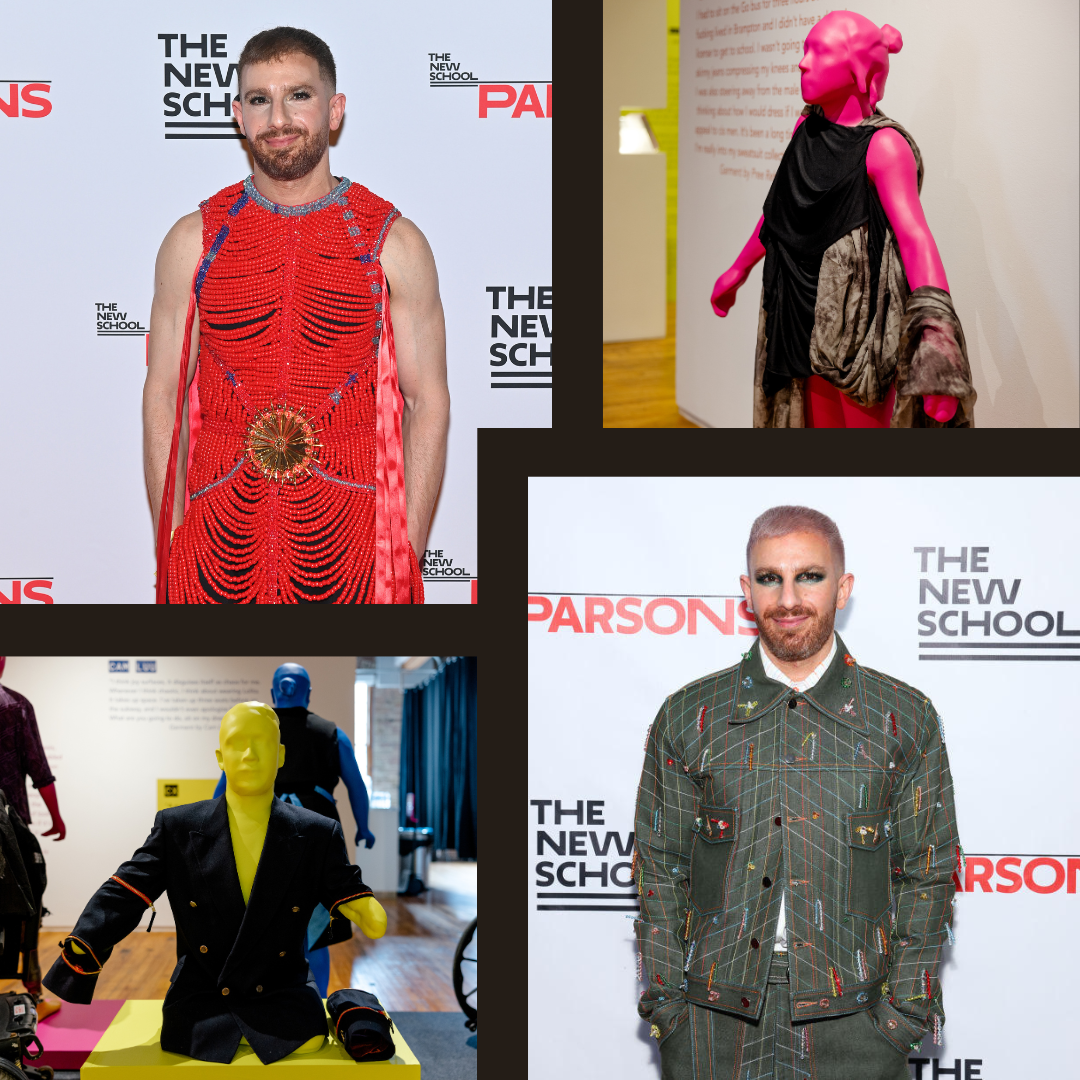
Images (clockwise from top left):
Ben Barry wearing a beaded red ensemble by Parsons MFA Fashion Design and Society alum Jontay Kahm at the 75th Parsons Benefit. Photo by Roy Rochlin.
Custom-made magenta colored mannequin of collaborator Sean Lee dressed in a top designed by him and Diego Ortega exhibited at “Cripping Masculinity: Designing Fashion Utopias” at Tangled Art + Disability, March 10 - May 12, 2023. Photo by: Michelle Peek.
Ben Barry wearing a green embroidered jacket and pants by Parsons BFA Fashion Design alum Jacques Agbobly at the 74th Parsons Benefit. Photo by: G. Arturo Holmes.
Blazer with modular sleeves designed by collaborator Georgy Dhanjal and Aris Cinti on a custom-made mannequin of Georgy exhibited at “Cripping Masculinity: Designing Fashion Utopias” at Tangled Art + Disability, March 10 - May 12, 2023. Photo by Michelle Peek.