Dialogues on Dress: Sara Idacavage
Or latest interview is with Sara Idacavage, who is a fashion historian, educator, and sustainable fashion expert.
The history of dress and the future of fashion act in dialogue, always interfacing to inform our present moment. The Costume Society of America’s diverse members exemplify this reality like no other; through the constant connections across time and disciplines they draw, our membership of costume curators, designers, artists, and so much more embody fashion’s ubiquitous presence - and dress’s daily power to teach us all something new.
We hope you will join us for CSA’s new Dialogues on Dress series, interviews now available monthly in our e-News and here on our website.
Interested in getting in touch? Email enews@costumesocietyamerica.com
Dialogues on Dress: Sara Idacavage
Sara Idacavage is an educator to her core, and our conversation is testament; an hour long dialogue–spanning from fashion history to ecoanxiety, Derrida to being an “archive gnome”–left me eager to only plunge further into her ideas even long after our interview ended. Which is precisely Sara’s teaching philosophy: getting to “the heart of a deeper perspective shift,”empowering her students, cracking history and its questions wide open. As a professor, lecturer, archivist, writer, and more, she works at the intersections of material culture and history, exploring how informing ourselves of the past can help us become better people today. Whether espousing the importance of empathy-informed teaching, sharing a passion for home economics education or fashion’s relationship to industrialization, or giving some real actionable advice (wash your clothes less often), Sara’s takes are refreshing, nuanced, and full of possibility.
A common thread across conversations with sustainable fashion experts is perhaps surprising; rather than a sense of doom, they express persistent faith in people to do good, gratitude for the work they pursue, and genuine excitement about what history can provide for the present and future–a sense of connection, motivation, and more. Sara embodies this sentiment to a T, and is a remarkable role model in the field of fashion.
This interview has been edited and condensed for clarity.
___________________________________________________
Please paint a brief sketch of your background, personal & professional.
Once upon a time, I really wanted to be a fashion editor. After I finished my undergrad in Fashion Merchandising at the University of Georgia, I moved to New York City, and I did work in journalism for a few years. Eventually I realized it was not for me; I just didn’t have the necessary passion for writing about all the latest trends and most recent store openings. I had a bit of an early existential crisis, which led me to getting my MA at Parsons in Fashion Studies. I had fallen in love with fashion history as an undergrad, but I didn't really understand how that could be a career until then. After Parsons, I was in museums and archives for a few years, including the Ralph Lauren Library, PVH, The Museum of the City of New York, and the New School archives. At that time, I was invited to come back and teach class. I had never thought of myself as a teacher, in fact, that sounded like the worst punishment I could think of. But I immediately caught the bug and really found my true calling in teaching. I was so inspired by sharing all my historical knowledge with the next generation of fashion professionals. I spent years as an adjunct instructor at Parsons, Pratt, and FIT, and then went back to the University of Georgia to get my PhD. Now I'm an Assistant Professor in the Journalism Department at Southern Methodist University [in Dallas, Texas.] So it’s a bit of a full circle moment, now teaching aspiring fashion journalists in the same shoes as myself 15 years ago.
I would love to hear how you would characterize your relationship to dress over the years. How has fashion influenced your work as well as personal journey?
I was just talking to my students about this… I think I've gone from being a consumer of fashion to a collector of fashion. I will be the first to admit that I am a reformed fast fashion addict. As much as most of my career is now based on sustainability and fighting against fast fashion, I also give it credit for helping me develop the identity that I have today. Growing up, I was getting all of my clothes from Kmart and Target. Then when I went to college in Georgia and later moved to New York, I suddenly had access to all these beautiful designs, even from fast fashion stores. I got to figure out who I was by trying so many different looks, but I have to admit that I maybe took that a little too far; I worked right above Zara and H&M, in Soho, and so it became almost a weekly activity to go shopping, pick up new things, and then at the end of the season donate everything to Goodwill. Because I - like so many people - was a believer that everything I donated was needed by somebody else. Even before I really started to learn about the environmental and social impact of the cycle I was stuck in, I began to feel that it wasn’t right. I felt trapped in a hamster wheel of consumption. This was at the same time I was learning a lot more about fashion generally, so I started going from buying mass quantities of cheap things to investing in vintage clothes. Which luckily, New York City of course has plenty of. My career as an archivist and a teacher blends into my life as a consumer. I have to practice what I preach.
~Learning about these random bits of history actually made [my students] rethink their own consumption habits more than learning about contemporary issues. I think they felt numb to our modern problems; they were so inundated with this information that they almost stopped hearing it at all [...] The key as an educator is to link those history lessons to you, in the present.~
How did you decide to focus on sustainable fashion in your research and teaching? Does a particular memory or course stand out?
I would love to say I had this great epiphany or took a life changing class, but that’s not really the case. Now, there is a lot more education about sustainability in fashion, but that wasn’t a huge topic when I was a student. I think that my real defining moment from a pedagogy standpoint was when I was teaching textile survey classes at Parsons; I started going down rabbit holes looking at how people valued their clothing differently throughout history. I taught my students about how in the Renaissance, clothing could be treated as an alternate form of currency, things like that. I recall that in my course evaluations at the end of the semester, my students described how learning about these random bits of history actually made them rethink their own consumption habits more than learning about contemporary issues. I think they felt numb to our modern problems; they were so inundated with this information, that they almost stopped hearing it at all. But when they started learning about fashion history and had that one degree removal, it helped them think about their clothing and consumption practices in a way that felt fresh and more manageable. So that's really when I started to think: I actually can make a difference as a fashion history teacher. There is a lot of possibility in this field. All of this led me to get a PhD and down the path I’m on today. It’s not pretty and no one wants to think about themselves as part of the problem. But if we’re talking about history, we can look at things with a bit more judgement perhaps. The key as an educator is then to link those history lessons to you, in the present. To show how, by the way, you’re still very, very intertwined and part of this system.
What spurred your interest in fashion history prior to becoming a teacher?
My PhD was actually in the Textiles Merchandising and Interiors Department at the University of Georgia, and even though I was studying history and sustainability, my PhD is technically in Polymer Fiber and Textile Science; which is very misleading, because I’m not doing any science… When I was getting my PhD, in addition to taking courses in things like consumer behavior and fashion related theory, I also took a lot of classes in the History school, Art Education, even Science Education, basically just different educational theories. So I would say my PhD was basically only 10% fashion. It was 90% all of these other subjects, and that's actually what I learned from the most. My dissertation looked at the historical development of fast fashion, particularly mail order catalogs, like from Sears, Roebuck & Co. Everything I do is always oriented around material culture. I love digging through an archive for days and days and days. That's my happy place for sure. I looked at how these catalogs presented thousands of clothing options to people living in rural areas that had maybe never seen a department store before, and they were all of a sudden given access to all of these things. My dissertation research, and really ongoing research, is kind of a social and cultural history of industrialization. I'm using clothing, but honestly I could be using happy meals or buildings or sofas or anything to kind of tell a similar story. I think clothing is the one that we instantly relate to - it’s like a shortcut to get people to understand.
Do you teach any courses on the social and cultural history of industrialization and fashion?
Yes and no, actually. I teach a fashion history class at SMU framed around sustainability. Every week, I have what I call a sustainability spotlight. If we are talking about the 1700s, we will talk about Marie Antoinette and all the fun stuff, but we are also going to talk about the cotton craze and colonialism. When we are talking about the '80s, we are going to talk about shoulder pads and MTV, but also neoliberalism and Reaganomics and how that kind of led to offshore productions. So I always tie it into industrialization, which I wasn’t capable of effectively doing before my PhD. It was really years of dedicating myself to rethinking how I approach teaching fashion, and now I'm actually putting it into practice. It’s also looking at the history of consumer behavior, which is something that's different from maybe your typical art history classes or what I used to teach at Parsons and FIT. But it’s interesting because I am in the journalism department, so I have to think about that context and what journalists would need to know. In that way, I actually have the freedom to go a lot more into the history of consumer practices, because that is something that they need to write about.
~A lot of my research is about reforming fashion education and taking into account the mental toll on these students becoming more climate aware [...] As an educator, I think it’s important to be aware of the emotional impact you’re making, while also trying to provide a lot of nuance and real actionable things that I hope people find helpful. ~
If you could distill some of your lectures and teachings into just a paragraph, what would you most like to communicate about fashion and how we can cultivate a healthier - for the planet and ourselves - relationship to it?
I think I always try to propagate a very problem-oriented approach to history. Not that there's anything wrong for history, for history's sake. There is a lot of joy to be had in looking at fashion history, but I am always trying to layer in a viewpoint of: how can we use this to look at our own modern consumption habits more critically? Where is that context, how are we connected to all of this now? My friend always tells me that I'm kind of like a Trojan horse when I do public lectures. We are talking about the 20s, people are expecting fun and glamour, but then suddenly we are talking about capitalism and colonialism. I like to see if I can push people to question things a little bit deeper, and walk away looking at their own closets or habits a bit differently.
My research goes into a few tracks. One being how do we use history to look at sustainability more critically and vice versa. Another track is mental health. A lot of my research is about reforming fashion education and taking into account the mental toll on these students becoming more climate aware. I have been thinking about this a lot with the book I am currently working on and exhibitions and journal articles, how there is a huge existential crisis resting in this knowledge. How can educators use that in a way that's going to encourage people to take action, instead of just curling up in a ball and hiding? As an educator, I think it’s important to be aware of the emotional impact you’re making, while also trying to provide a lot of nuance and real actionable things that I hope people find helpful.
What are some tips for people who are just starting to rethink their consumer practices?
My answer changes constantly. As much as I really would love to encourage things like mending, repurposing, etc. - which I do think is great - that takes a lot of time and there is a degree of privilege in having that time. That stuff was historically a part of everybody’s general knowledge and day to day, but it isn’t anymore. But at the very least, you should take the time to pause and reflect on what your needs are. I think I am always trying to get at the heart of a deeper perspective shift, and then hope that the behavior shift comes after that. So ideally, yes, tell everybody to mend their clothes, to research their brands more thoroughly, etc. But at the end of the day, just having an open mind to these things and thinking about them is a start. And then also, of course, remembering that sustainable fashion is not tied to any sort of price point and it isn't unreachable. This shirt that I’m currently wearing, it's from Zara, but I've had it for like 18 years. Take better care of your clothes, and wash them less often. I wear a lot of undershirts. The idea of washing your clothes frequently is such a modern phenomenon, not to mention something that is promoted by Big Laundry. Washing your clothes less, that is a small thing with a big impact. At the end of the day, it is sort of a personal decision as to what you have time for.
What are some favorite courses you’ve taught, and what do you find students today most inspired by or excited about??
I have to admit, I love teaching every single class because I think there is always an opportunity to integrate my nerdy, niche little fashion history topics in it. That's one of the great things about fashion, its interdisciplinary nature. I love surprising students with things they might not expect to get in a fashion class. One of my core classes I teach at SMU is called Understanding Fashion Design, and it's a real treat because I'm teaching journalism students; they're not designers, they don't have that pressure , but the class teaches them how to understand and describe all the things that go into fashion design. Even though there is nothing explicitly about sustainability in the course, every single part of it is just building that perspective shift in understanding and appreciating materials, appreciating the labor that goes into it.
But probably my most rewarding course has been University of Georgia's first ever sustainable fashion elective in 2023 that I got to introduce as a PhD student. The class ended with the students doing a public education exhibit. It was really rewarding for me to essentially teach my students to be teachers themselves, because I can only have an impact on a few dozen students each semester, but they can go out and have an impact on hundreds more. A lot of the exhibits were interactive, and about things like natural dyeing, fabric identification and laundry, and really overcoming ecoanxiety and instead channeling it.
I think in a lot of ways, my job is less about teaching people habits and more how to be better communicators. It is hard to communicate these big, scary concepts. We even have weeks dedicated to having difficult conversations with parents and grandparents. How do you talk to your sister who has a Shein addiction or your mom who can’t stop filling her Amazon cart? I like to make homework assignments that are about that, building scripts and developing communication skills. It will carry over into any professional work they do as well.
~Maybe from a marketing perspective, [the language of sustainability] is problematic because it has this amorphous definition, but I think that there is a benefit from an education perspective to having the lack of solid definition. It makes it easy to open it up for sources of debate. [...] It’s a good word if it makes us think harder, rather than giving us a shortcut to the answer.~
Are there any recent projects - curatorial, writing, or otherwise - you’d like to share about?
I like to think of my job as that of a storyteller. So whether I'm writing a column, teaching in a classroom, or curating, it is always about telling a story. My stories have changed over the years, but I have consistently found objects to be one of the most powerful and impactful ways to get those stories across. There are plenty of studies on how objects are an effective pedagogical tool. But I think it also helps us overcome our biases and our assumptions. Giving students a garment from the past, and adding a layer in a lesson about sustainability or culture appropriation, that object forces them not to immediately make an assumption about what that lesson will be about, because they are much more focused on things like their physical, personal connection to it.
With my appreciation for objects and their use in my teaching, I am always digging around the archives. I love being a little archive gnome. That led me to a recent project, which was an exhibition at the University of Georgia called From Farms to Fast Fashion, Unraveling the Need for Sustainable Style. I had carte blanche to curate an exhibition with the vague theme of sustainability. There were a limited number of mannequins, so I was thinking about, how do I tell the story in a way that is less about the clothing and more about the systems that make clothing consumption possible? I had things like records related to textile mills, child labor photography from Louis Heim, the social reform photographer, stuff pertaining to sharecropping and slavery or factory work. I also had things related to one of my passions, which is home economics education, and the Work Progress Administration and the Georgia Cooperative Extension Service, which were all these institutions that taught women how to better care for their clothing and how to be these more responsible consumers. It wasn't about saving the environment then, and more about how to be a good wife and a good mom. But all of these materials look exactly like what we're striving for today. The exhibition ended up being an exploration of the acceleration of fashion and advent of fast fashion, but doing it through unexpected material. That has really been a passion, telling these stories with objects that maybe people don't even associate with fashion.
I'm also now working on a book with a friend of mine who's a brilliant writer and scholar, Lauren Downing Peters. We are editing a book called Teaching Fashion Sustainably with Bloomsbury publishing. It should come out in 2026, and it has 60 chapters with a lot of amazing contributors discussing how they implement sustainability into their teaching practice. The idea is that you teach costume design or window merchandising or runway production, and there is going to be some sort of activity or chapter that speaks to how you can place sustainability in your class. It is very much in line with the ethos that sustainability should not be its own elective, but instead integrated into every single class.
I am always curious to hear opinions on the language we use surrounding “sustainable” fashion.
[The language aspect] is obviously frustrating… the more that you work in ‘sustainable’ fashion, the more you see the pitfalls of the words we use to talk about it. But at the same time, I believe it's a very helpful tool because at least it can be used as an umbrella term for lots of different things that are essentially working towards the same goal. Maybe from a marketing perspective, it is problematic because it has this amorphous definition, but I think that there is a benefit from an education perspective to having the lack of solid definition. It makes it easy to open it up for sources of debate. I think of it as similar to terms like feminism or even spirituality, where there are a lot of different ways to define it. That is part of the fun and the challenge, having debates around how to define it, and it also makes it in some ways more useful. I love the idea of taking a term and opening it up, deconstructing it. I am a big fan of Derrida. I think that when you are kind of deep into fashion studies, you start to see these Western paradigm types of binaries everywhere. And then it’s fun to get to that level of thinking where you realize, wait a minute, nothing is black and white. It’s a good word if it makes us think harder, rather than giving us a shortcut to the answer.
What else is on your mind these days?
I am trying to finally enjoy where I am today because I think that in academia, you can just work so hard, go get the PhD, get the job, go go go. But now I am having a pinch me moment, because I am so lucky to do what I do. I am still often stressed out… but it is such a special job to get to talk about fashion. It is a job that usually makes people's lives better, and that so many people can connect to. People love to talk about fashion. I get to travel, to meet people all around the world, and I still can’t believe this is my job.
What does the future of fashion look like to you?
I think that, like so many people who work in sustainability, there are ups and downs of going from being really optimistic to really pessimistic. I think it is my job to look for the bright spots. If I am going to try to train and educate future fashion professionals, I cannot just throw my hands up and say everything sucks, peace out, that’s all. I have to figure out how to get back to that bright side. I see what my students are doing today, like clothing saps or meeting for the sustainable club at SMU that I founded, and I think about how they are doing things I never would have dreamed of when I was their age. That gives me hope in the future. I try to take it day by day, step by step. It is easy to feel like you have to solve all the world's issues, to see these things as so systemic that they are beyond our control. I try to remember that the biggest difference you can make is what you can do right here, right now. And after you do that, you'll find what the next thing is tomorrow.
Fashion historians are in a very exciting moment, with all these different platforms that never existed before allowing us the opportunity to connect. The public wants to connect more and more to the past, wants to understand our history and how we can do better now in the present. It truly just brings me a lot of joy.
___________________________________________________
Thank you so much to Sara Idacavage for having this conversation with me! You can find her here, and keep an eye out for the forthcoming publication Teaching Fashion Sustainably in 2026!
~Madison Brito Taylor
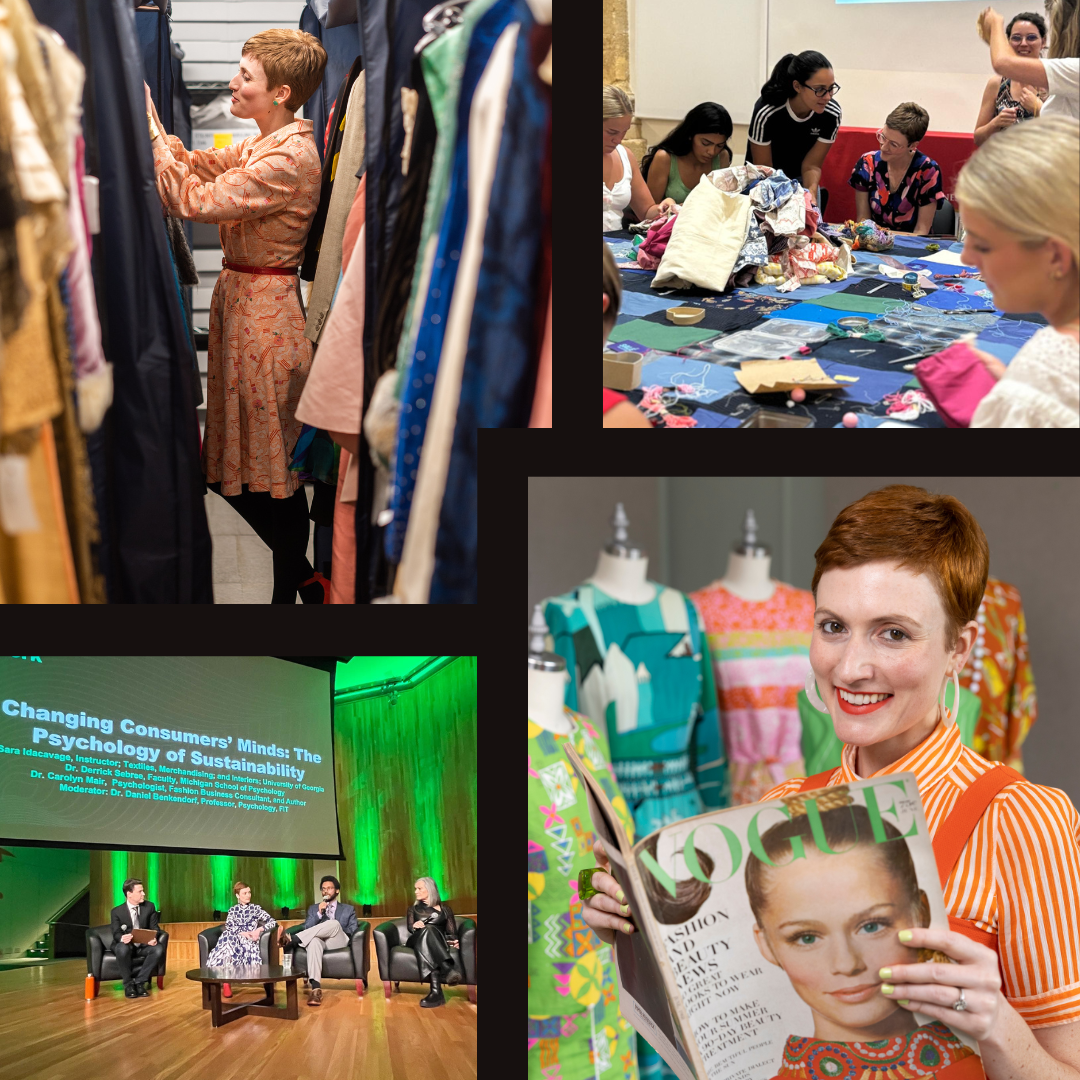
Images (clockwise from top left):
Photo by Liisa Jokinen
Sara teaching students
Photo by Peter Frey (also banner image)
Sara speaking on sustainability panel at FIT