Dialogues on Dress: Cassidy Zachary
This month we spoke with Cassidy Zachary, fashion historian and co-host of the beloved podcast, Dressed: The History of Fashion.
The history of dress and the future of fashion act in dialogue, always interfacing to inform our present moment. The Costume Society of America’s diverse members exemplify this reality like no other; through the constant connections across time and disciplines they draw, our membership of costume curators, designers, artists, and so much more embody fashion’s ubiquitous presence - and dress’s daily power to teach us all something new.
We hope you will join us for CSA’s new Dialogues on Dress series, interviews now available monthly in our e-News and here on our website.
Interested in getting in touch? Email enews@costumesocietyamerica.com
Dialogues on Dress: Cassidy Zachary
If you’re reading this, you are likely interested in fashion. And if you’re interested in fashion, you have likely listened to at least one episode–or perhaps hundreds–of the beloved podcast, Dressed: The History of Fashion. After all, there are 8 seasons, 575 episodes and counting. Dressed, which our guest Cassidy Zachary co-hosts with April Calahan, explores dress’ ubiquity across time, space, and culture; thus there are “truly infinite topics,” the podcast a goldmine of education and enrichment, as its hosts constantly show you just how connected fashion is to quite literally, everything. It is no wonder Dressed’s co-host is herself a wellspring of knowledge and inspiration. If you want to learn more about fashion, you should listen to Dressed, but also follow Cassidy’s work beyond the podcast–whether that is tuning into her account The Art of Dress, signing up for one of her courses, reading one of her many publications, or reading this interview. “Raised to believe in magic,” Cassidy injects vivacity and life into fashion history, her belief in “fashion as not just a noun, but a verb” contagious through conversation. Below, learn more about her journey starting The Art of Dress back in 2011, her favorite fashion history makers, and always expanding our definition of what fashion truly is.
This interview has been edited and condensed for clarity.
___________________________________________________
Please paint a brief sketch of your background, personal & professional- from your earliest memories of fashion to current career and beyond!
I always ask guests on
Dressed [the podcast] what their earliest fashion memory is, and yet I can never quite pinpoint my own. But I remember making doll clothes for my trolls and stuffed animals, and I think my entry point into fashion was being read fairytales. A lot of these fairytales have historical fashion in them, like one of my favorites,
Lady with a Ship on her Head. As I got older, I really responded to fashion magazines with magical elements, like
Tim Walker. The intersection of fantasy and fashion is really what initially inspired me. I initially wanted to be a designer and embarked on a career in costume design after college [at University of New Mexico, with a BA in Theater Design]. I realized fairly quickly the only thing I enjoyed about designing was the historical research. I came across Valerie Steele’s book,
The Corset: A History, and that totally changed my trajectory–it’s how I discovered you could make a career as a fashion historian. I went to FIT for my Masters, and met April Calahan [Cassidy’s co-host on
Dressed] in the special collections department during an internship. It was love at first fashion plate. I assisted her on that first book, we wrote more
together, and the podcast evolved from there. After FIT, I got a job as a Collections Manager and spent two years cataloguing almost 10,000 pieces. But April and I stayed in touch throughout that.
What speaks to you in particular about fantasy and fashion?
I was raised to believe in magic. My childhood was infused with fantastical elements, and that sent me down a really creative path through dress. These children’s books still speak to me today–their evocative art and beauty–and exposed me to art at a young age. It led me to connect fashion with storytelling, and embrace the idea that clothing is an entry point to understanding character. That is still what I love most about fashion, the stories it tells.
I would love to hear how you would characterize your relationship to dress over the years. How has fashion influenced your work as well as personal journey, or what role has fashion played in developing your sense of identity?
I think about this a lot, but the irony is that on a personal level, I don’t feel I engage with contemporary fashion much. I can appreciate the artistry and fantastical aspect of it, and I so admire people who use their body as this very expressive medium, but I’ve never quite gotten there myself. But I have always really connected with jewelry. It’s such a powerful form of dress and like armor for me–I put it on before I leave and take it off when I get home. Some of my earliest memories of fashion are through jewelry, as I inherited a lot of costume jewelry boxes. My wedding ring is a family heirloom from the 20s, and I wear a 19th century locket that belonged to my great great great grandmother a lot.
~I was raised to believe in magic. My childhood was infused with fantastical elements, and that sent me down a really creative path through dress. [...] It led me to connect fashion with storytelling, and embrace the idea that clothing is an entry point to understanding character. ~
Let’s talk about your podcast, Dressed: The History of Fashion. How did it start, and what do you cover for those unfamiliar with it?
April was living in NYC, I was in New Mexico, and she was offered an opportunity to start her own podcast. She invited me along, so we started Dressed in 2018 on iHeart Radio. Fast forward to today, we are now independent as Dressed Media. We just concluded our 8th season today [December 2025] and have 575 episodes. The tagline of Dressed is we are a podcast about the cultural and societal significance of the clothing we wear, with this idea that dress is something that connects us all. The running thread throughout all the episodes is that dress brings us together, spanning time, space, and culture. We always joke that the podcast could go on forever–there are truly infinite topics within the world of dress.
I’m particularly curious about how you source ideas for each episode and decide what to cover.
As long as something has to do with dress, it is fair game. I am constantly inspired by the world around me. Social media is actually a significant source of inspiration. I have connected with so many guests that have subsequently appeared on the podcast through social media. For instance, the costume designer of Wicked, Paul Tazewell, I’ve interviewed him twice now and first connected with him via social media. Likewise for Mona May, the costume designer for Clueless, or fashion historians like Gino Gonzalez. For Gino, I found his beautiful account full of 19th and 20th century Philippines fashion images. You can connect with people all over the world through social media. We take listener emails for ideas, and we do episodes called “What's in your Closet,” where listeners send us an item from their closet which we then research.
~I love how Jonathan Michael Square and other scholars define fashion as not just a noun, but a verb. It is an active practice with the body. When you expand your brain to grasp fashion as an act and a practice, the world is endless. All of history opens itself to you.~
How has hosting the podcast, for now 7 years, affected your relationship to fashion?
My definition of fashion has expanded exponentially thanks to this podcast and everything, or really everyone, it exposes me to. I am exposed to the work of so many scholars and creators who live their own definition. Within the academic world of fashion studies, from when I began in 2010 to now, our field has drastically evolved. A prime example is the Fashion Race Database, run by Kimberly Jenkins, who really educates and challenges people to expand our idea of what fashion is. Historically, fashion has been studied through a narrow lens that defines it exclusively within European and North American terms. I was just arguing with someone on the internet about how there is so much innovation and fashion to be found in other cultures. The idea that fashion has to be rapidly changing and seasonal might be true within a European or North American context, but that is absolutely not to say that the cultures where this looks different don’t have vibrant and incredibly rich fashion narratives. I love how Jonathan Michael Square and other scholars define fashion as not just a noun, but a verb. It is an active practice with the body. When you expand your brain to grasp fashion as an act and a practice, the world is endless. All of history opens itself to you.
~I also have to give a shoutout to Tony Vaccaro, such a seismic force, who joined me on the podcast five or so years ago. He was a WWII combat soldier turned fashion photographer, because he needed so desperately to find beauty after the atrocities he witnessed. [...] Fashion was an entry point and excuse to get to talk to this incredible human and learn more about his career. Those are the episodes I am most proud of throughout my career, where I got to meet these people with such incredible impact.~
Do you have a favorite episode(s) covering an area of dress that isn’t typically as well represented?
Gino’s book that he co-wrote, Fashionable Filipinas, looks at how these women created a hybrid fashion culture during Spanish colonialism, which lasted almost 300 years. They used dress as a mode of resistance and subversion to create such a unique fashion identity that exists to this day. I met Gino’s co-author, who told me about his mother, Salvavion Lim Higgins, an incredibly groundbreaking Filipina fashion designer. She opened her salon the same year as Chrsitian Dior. We all know Dior, but how many of us know Lim Higgins? Her body of work is incredible, and I was so excited to have Mark Lewis Higgins on the podcast to share about her. Gino linked me to Mark, and I connected Mark to a curator friend, and they’ve now collaborated a bunch together. Through Mark, I met the Editors of Vogue Philippines, and they’ve now come on the podcast. You really just find a connecting thread everywhere in the world of dress and meet so many people and places.
One of the most special things about the podcast is connecting with fashion history makers: people who have deeply shaped fashion history thanks to their careers. I’ve been honored to interview several of them, like Mary Wilson, one of the founding members of the Supremes. Little do people know she was also their wardrobe archivist, and she kept everything they wore. Also David Wolfe, a prolific paper doll artist and important trend forecaster in the 70s-90s. I also have to give a shoutout to Tony Vaccaro, such a seismic force, who joined me on the podcast five or so years ago. He was a WWII combat soldier turned fashion photographer, because he needed so desperately to find beauty after the atrocities he witnessed. He was friends with Georgia O’Keefe, photographed Pablo Picasso, and more. Fashion was an entry point and excuse to get to talk to this incredible human and learn more about his career. Those are the episodes I am most proud of throughout my career, where I got to meet these people with such incredible impact.
In addition to hosting Dressed, I know you’re also the founder of the popular social media account @The_Art_of_Dress. Can you tell me a bit about this aspect of your career.
I started The Art of Dress in 2011. I was one of the first accounts to do niche fashion history; they’re everywhere now, but then it really just felt like myself and the_corsetedbeauty. I focused on the 1910s, because it’s fascinating and such an overlooked era, and it just kind of blew up from there. Miley Cyrus and random celebrities followed me at the time, which helped me grow so much. I feel blessed that I got to share my passion and cultivate a community around the art of dress. My account is definitely one of many arms of my fashion history world; it’s a little more personal than Dressed, and I plan on developing the account more into its own entity in the next year.
Juggling many projects at once definitely comes with the territory! How do you stay balanced, or how do you stay inspired?
I take it day by day. It’s very fluid, and very interesting to be your own boss. A lot of lists, a lot of planning, and I try to turn everything off and definitively, actually end my work day when it’s time to pick up my kiddo and be with my family.
Fashion is one of the most intimate items that people own, which makes it an endless source of inspiration. We can all relate to it. There are very few things you can say are truly universal. Because of its intimate relationship to ourselves and our societies, it is an incredibly powerful tool of communication. Whether it is your own self-expression or what is imposed on you from the outside, it is both a private and public item. Dress and its stories are a hugely powerful entry point to understanding the human experience and history. That is what has always inspired me, the threads we can pull from pieces of dress to weave a narrative and the incredible people that work within this medium, telling stories and teaching us something new.
Could share a bit about the classes, trips, etc. hosted through Dressed and how that came to be?
This past year was our seventh or eighth fashion history tour of Paris. It’s a great way to connect with our listeners in person, which I don’t get to do often as I’m not based in NYC. We also get to pull together resources, like all the curators or museums we’ve connected with, through tours. Our classes started as another way to connect; we have vibrant and engaging chats, and we get to dive deeper into these fashion history concepts. I’ve taught on different decades/eras of fashion history, and we are doing the 1770s-1840s beginning in January. I develop my own curriculum for these classes, which is a good deal of work.
To conclude our chat–what does the future of fashion look like to you?
I hope it is a return to people valuing the clothing that they wear. We are such a throw-away culture, and we produce fashion at an abominable speed. It is a path of destruction, and because of this culture, many of us have lost our connection to the true value of clothing. Hopefully we’ll see more and more people appreciating craft and the work that goes into dress, the unseen labor. Everything we wear is made by a human, and we should never lose touch with that human element that exists at all times.
___________________________________________________
Thank you so much to Cassidy Zachary for having this conversation with me! Find her here, and find Dressed: The History of Fashion wherever you listen to podcasts.
~Madison Brito Taylor
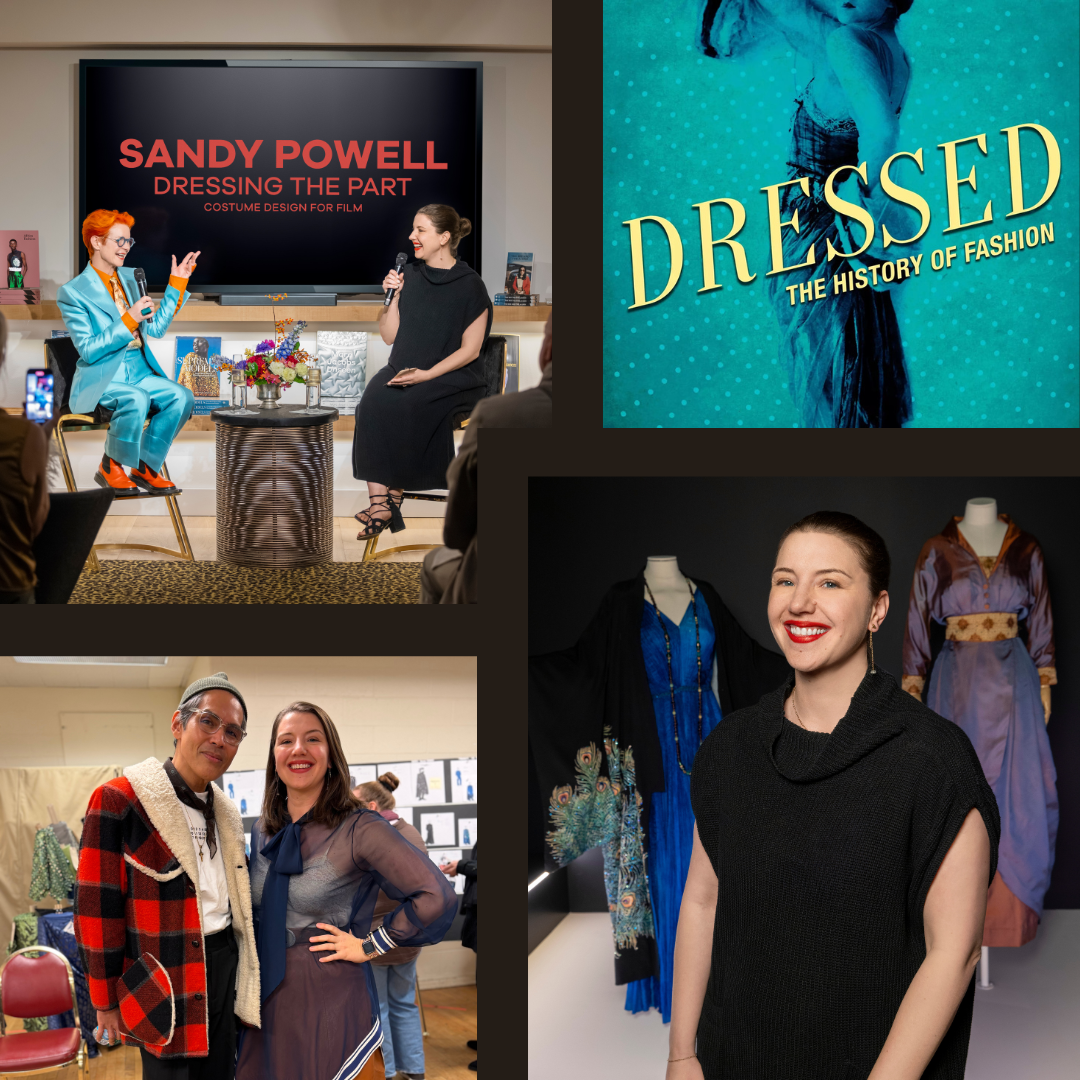
Images (clockwise from top left):
Cassidy interviewing costume designer Sandy Powell for the opening of the exhibition Sandy Powell’s Dressing the Part: Costume Design for Film at SCAD FASH in Atlanta in 2025*
Dressed logo
*Cassidy at the above interview
Cassidy and designer Clint Ramos after a conversation conducted at the Metropolitan Opera during Dressed’s recent Day Tours of NYC, December 2025