Dialogues on Dress: Laura McLaws Helms
This month we spoke with Laura McLaws Helms, fashion historian, writer, and collector.
The history of dress and the future of fashion act in dialogue, always interfacing to inform our present moment. The Costume Society of America’s diverse members exemplify this reality like no other; through the constant connections across time and disciplines they draw, our membership of costume curators, designers, artists, and so much more embody fashion’s ubiquitous presence—and dress’s daily power to teach us all something new.
We hope you will join us for CSA’s new Dialogues on Dress series, interviews now available monthly in our e-News and here on our website.
Interested in getting in touch? Email enews@costumesocietyamerica.com
Dialogues on Dress: Laura McLaws Helms
Laura McLaws Helms is a modern Renaissance woman of freelance fashion, her career as “diverse as styling actresses in vintage for the red carpet, building an archive for a famous band, editing a magazine, and running a clothing company,” all before her current focus of history-related work. As a freelancer from the get-go of her career, Laura’s experience is extensive but also focused; she is a lifelong vintage lover & collector and brilliant writer, from her book on Thea Porter published in 2015 to her current Substack column on fashion and cultural history. Below, she discusses enjoying the ride—where “somewhere along the way of trying out different tasks, you end up discovering your unique purpose and message”—how becoming a mother has affected her relationship to fashion, collecting in the pre-eBay years, and much more.
This interview has been edited and condensed for clarity.
___________________________________________________
Please paint a sketch of your background–personal, academic, & professional—from your earliest memories of fashion, to academics, hobbies, career, or beyond…
For as long as I can remember, I’ve been interested in clothing, particularly vintage and historic clothes. Most of my memories of being a small child somehow involve fashion; whether spending hours intently staring at my mother’s 1970s copies of Regency romances, memorizing every Barbie ever made through collector’s manuals, watching 1940s Deanna Durbin films with my grandfather, or having my grandmother walk me through her wardrobe of garments going back to the 1930s, it always came back to clothes. As I was always more interested and excited by decades earlier than my own, I started wearing vintage as a pre-teen—in those pre-eBay years, I would search through car boot sales and secondhand shops for cool seventies t-shirts, records, posters, and teen annuals, slowly building an understanding of culture that forms the basis for my career today. By my teens, I was deeply into researching, collecting, and wearing sixties and seventies designers.
I studied photography as an undergraduate at NYU Tisch, where I gained a strong foundation in photographic history and the close analysis of photographs for historical research. Once I realized that being a fashion historian was a real career, I went to FIT to get my MFA in Fashion and Textile Studies and have been working in the field since then.
~At this point, I think it would be impossible to disentangle my sense of identity from my personal style. I’ve always been attracted to clothing that is fantastical, ornate, or historical revivalist in style—wearing these pieces has allowed me to simulate different lives and personalities while visually acting out my own education in fashion history.~
I would love to hear how you would characterize your relationship to dress over the years. What role has fashion played in developing your sense of identity?
At this point, I think it would be impossible to disentangle my sense of identity from my personal style. I’ve always been attracted to clothing that is fantastical, ornate, or historical revivalist in style—wearing these pieces has allowed me to simulate different lives and personalities while visually acting out my own education in fashion history. I enjoy wearing interesting clothes; one day that might mean a chic wool Geoffrey Beene dress from the mid-60s, while the next a velvet Renaissance-inspired gown from the early 1970s.
Having a child dramatically changed my day-to-day life. While I am dressing up for events much less often, in my daily life, I still only wear vintage—I’m just now looking more for inspiration in seventies candid photographs and old copies of
Redbook and
Ladies’ Home Journal, not solely the higher-end fashion magazines.
How has becoming a mother changed your relationship to fashion?
While I was always against fast fashion and concerned about the environmental effects of the fashion industry, having a child has greatly amplified my anger and worry. Thinking of his future makes the abstract very real. I find myself repelled not just by the industrial waste and labor violations of fast fashion, but by ostentatious consumerism as a whole—I’m definitely finding it difficult to engage with the fashion industry as a whole at the moment. While I’ve only worn vintage for a very long time, I’m finding myself drawn to paring my closet down (just a bit!) and focusing on repairing my favorite pieces.
Tell me about the different arms of your professional life. What are you working on lately?
My whole career so far, I have been a freelancer, so I have done just about every fashion history and fashion-adjacent job over that time. Over the years, I’ve done things as diverse as styling actresses in vintage for the red carpet, building an archive for a famous band, editing a magazine, and running a clothing company, but now I am concentrating on history-related work. For freelance clients like fashion houses, beauty companies, and publishers, I write, edit, fact-check, and research (historical text-based, photo, and video), as well as create mood boards and historically informed trend forecasts. One key part of my career is helping brands and companies learn and incorporate their heritage into their messaging and products, through archive-building and historical brand strategy.
I am additionally in the middle of writing a dress history book (hopefully to be published in autumn 2027). I also write a Substack newsletter, Sighs & Whispers, about fashion and cultural history, and have a podcast where I interview older creatives about their lives and careers. It’s definitely a labor of love—one that costs a lot to produce and makes no income—but I am so grateful that these artists and designers entrust me with their stories. For many of my interviewees, the podcast is the only interview they have done in their later life, and many have passed away since we spoke. Whenever I receive an email thanking me from a friend or family member of theirs, or someone researching them, it makes all the hard work worth it.
As those in creative industries will relate to, juggling many projects at once comes with the territory. How do you stay balanced, and how do you stay inspired?
The benefit of freelance work is that every day is different. It isn’t the most lucrative and finding work can sometimes feel impossibly stressful, but as every project is so varied, there are so many opportunities to learn something new and find inspiration. Often when I am researching for a client, I come across many ideas that I want to investigate further—I keep a long list of ideas to return to, which feeds my writing for my newsletter and other outlets.
Juggling many projects has become much harder since having a child. Mornings, afternoons, and weekends are now toddler time, so I have so much less time to devote to work. To stay on track, I maintain several to-do lists, which I constantly come back to throughout the day, but I still struggle to finish everything. Balance is definitely a work in progress. I’m always interested to hear how other writers, historians, and researchers manage motherhood and work, if anyone wants to share and/or commiserate!
~The benefit of freelance work is that every day is different. It isn’t the most lucrative and finding work can sometimes feel impossibly stressful, but as every project is so varied, there are so many opportunities to learn something new and find inspiration.~
What drew you to writing specifically as your line of work? How is it an apt vessel for sharing a love of fashion, and what are its challenges?
The great benefit of writing is that it can be done anywhere and requires really no overhead or outside funding, unlike curation. Obviously, you need money to support yourself, but you can fit in writing around other work. While I have loved curating exhibitions in the past, museum exhibitions are so expensive to produce that most of the work is kept in-house. Writing has proven to be the best way to share my love of history with others.
From my understanding, you’re very much a collector. Can you tell me a bit about this? I would love to hear anything from how you got into it, how you go about sourcing, or what designers you’re drawn to.
Growing up in London, every weekend I would visit Portobello Market on Saturday, Camden Market on Sunday, and Alfie’s Antiques Market after school, slowly building up a vintage education purely through looking and touching. I found my first early 1970s Ossie Clark dress by chance and was entranced—that one garment leading me on a research rabbit hole that I am still on today. I started by collecting what I liked, and slowly I realized that most of what I was collecting was in conversation with each other: the 1970s garments were inspired by the 1930s and 1940s ones, and all of the 1970s British designers were working and showing alongside each other. While I’ve expanded my research and collecting to other eras and locales, that initial group of 1960s-1970s London-based designers—Thea Porter (whom I wrote a book on), Ossie Clark, Bill Gibb, Zandra Rhodes, Gina Fratini, Janice Wainwright—will always be the center point of my collection.
Vintage has become much more collectible and expensive over the last twenty years, so I buy much less often than I used to, but I am always, always looking. I maintain large lists of hundreds of search terms on eBay, Gem, Live Auctioneers, Invaluable, and The Saleroom. While researching, I keep track of any lesser-known designers or stores to keep an eye out for. Since I wear my vintage, I don’t care if it's in perfect condition. You can often find amazing deals if you are able to look past imperfections. I have a late 1980s acid yellow Jean Muir coat with slight, imperceptible moth damage, which I bought for $20 on eBay—every time I wear it, people will run across the street just to tell me how amazing it is.
I also collect vintage magazines and books; I have a large archive of fashion, women’s, architecture, and interior design magazines from the 1920s through the 1990s, which I use as the basis for much of my research.
~I loved Thea Porter’s clothes, yet when I began looking into her, I quickly realized that the same three [Clark, Gibb, and Rhodes] were reprinted in every fashion history book—and that was it. Delving deeper, it soon became apparent that all that information was incorrect and that the truth of her life was much more intriguing. I contacted her daughter in London, who gave me access to boxes full of old documents, and I was off.~
What drew you to Thea Porter in particular?
During my first year of graduate school, we had to design our dream exhibition. As long as I’ve collected vintage, I’ve been obsessed with a group of London-based designers who, in the late 1960s and early 1970s, created clothes that could best be described as fantastical, exotic, and romantic. I knew I wanted to choose one of them to do this project on, but Ossie Clark, Bill Gibb, and Zandra Rhodes had all been the subjects of wonderful exhibitions previously. I loved Thea Porter’s clothes, yet when I began looking into her, I quickly realized that the same three [Clark, Gibb, and Rhodes] were reprinted in every fashion history book—and that was it. Delving deeper, it soon became apparent that all that information was incorrect and that the truth of her life was much more intriguing. I contacted her daughter in London, who gave me access to boxes full of old documents, and I was off. It was a joy to take that idea from an exhibition concept to master’s thesis to book and museum exhibition.
Describe a typical day of work (& perhaps some leisure) - or if no day looks the same, describe a good one! Do you have any favorite spots around NYC?
On a typical day, I work from home in Brooklyn. My husband usually takes my son to daycare so I can start working around 8.30, catching up on emails and planning my day. For the book I’m currently working on, I am doing a lot of interviews over the phone or Zoom, so I often have one or two throughout the day. I fit my freelance work, newsletter writing, and book research around those, before I leave to pick up my son at 4.45. After he goes to sleep, I read books related to my research.
Often, research takes me to the New York Public Library’s Rose Reading Room, FIT’s Special Collections, or the Met’s Watson Library, which always feels like a treat. When I’m feeling particularly off-kilter and unable to write, I will go to see a repertory matinee at Film Forum—somehow that always inspires and reinvigorates me.
What advice would you give to someone interested in pursuing similar work, just starting out in their career?
As I said earlier, this is not the most lucrative career, and the inconsistency of a freelance career is definitely not for everyone. What I think has benefitted me the most is always staying open and curious—I’ve been willing to try anything, work the most random jobs, and on seemingly very unrelated projects, but I’ve always learned something and met people. Being open will lead you to places you never imagined, to meet people you wouldn’t have otherwise, and expose you to new ideas and inspirations. Somewhere along the way of trying out different tasks, you end up discovering your unique purpose and message.
Over the next five years, how do you see your work evolving? Tell me about a dream project, a vision, or general directional mood…
I have so many fashion and cultural history book ideas that I would love to bring to fruition.
___________________________________________________
Thank you so much to Laura McLaws Helms for having this conversation with me! You can read and subscribe to her Substack here, and learn more about her here.
~Madison Brito Taylor
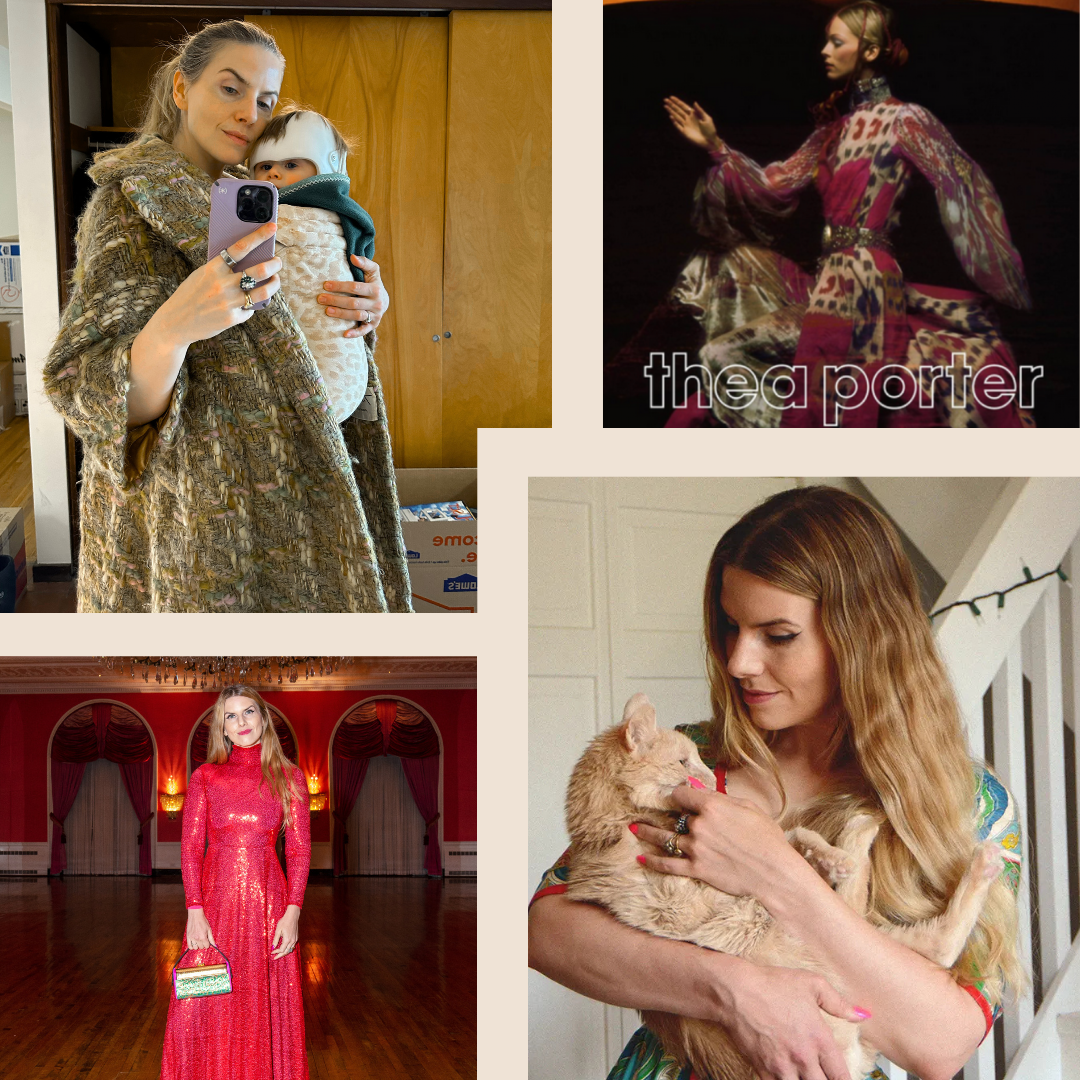
Images (clockwise from top left):
Images (clockwise from top left):
Photo courtesy of Laura
Book cover of Thea Porter: Bohemian Chic by Laura McClaws Helms and Venetia Porter, V&A Publishing
Photo by Jung Kim for The Wildest
Photo by Madison McGraw for Bienen David