Dialogues on Dress: Summer Lee Jack
This month we spoke with Summer Lee Jack, costume designer and professor at Middlebury College.
The history of dress and the future of fashion act in dialogue, always interfacing to inform our present moment. The Costume Society of America’s diverse members exemplify this reality like no other; through the constant connections across time and disciplines they draw, our membership of costume curators, designers, artists, and so much more embody fashion’s ubiquitous presence—and dress’s daily power to teach us all something new.
We hope you will join us for CSA’s new Dialogues on Dress series, interviews now available monthly in our e-News and here on our website.
Interested in getting in touch? Email enews@costumesocietyamerica.com
Dialogues on Dress: Summer Lee Jack
As a costume designer and theater professor, Summer Lee Jack is expert at dissolving the lines between disciplines. Whether that’s showing student athletes just how similar theater is to their sport, (think rehearsal, audiences, adrenaline, teamwork), bringing entomology professors into class to discuss insects and textile conservation, or simply discovering the joys of moving between scholarship and practice. After a robust career freelancing for theaters across New York City, with plenty of schlepping bags of garments on the subway, Summer now teaches at Middlebury College in Vermont as an Assistant Professor of Theater. In the balance of teaching design, sewing, history, conservation, and more, she helps students unlock their creativity and discover theater is for anyone and everyone. Through it all, her enthusiastic and unwavering growth mindset is palpable. Summer’s work is a needed reminder that “you just have to be willing to be bad at something before you become good at it. That's something all of us have to learn.”
This interview has been edited and condensed for clarity.
___________________________________________________
Please paint a sketch of your background, personal & professional—from your earliest memories of fashion, to academics, hobbies, career, or beyond…
I had a somewhat unusual path because I decided I wanted to be a costume designer when I was very young. I was about fourteen or fifteen, and I'd been doing theater; my mom thought performing would help me become a more confident person, and she was definitely right. But I loved the community and crafty aspects of theater much more than the memorizing lines or dancing part. That's when I discovered costume design. My mom worked in interior design, so I'd grown up learning about historical interiors through her. Design, storytelling, and theater all came together for me in high school, and I realized I could actually become a costume designer.
I went to college at Arizona State because I wanted the experience of attending a large university. During my first couple of weeks there, I walked into the costume shop and basically said, "Hi, I want to be a costume designer." They said, "You don't mind not getting paid? Great. Come on in." I had a wonderful mentor there, Connie Furr Solomon, who is still a professor at Arizona State today. She was incredibly encouraging, and I learned so much from her. We had a really supportive costume shop, and I had opportunities to design productions that many undergraduates don't usually get. I was enthusiastic and always available, so they gave me projects. I was very lucky to have that supportive environment. After Arizona State, I studied abroad in Paris. I attended the American University of Paris for a fashion program for a while. After school, I moved to New York and spent years freelancing for different theaters around the tri-state area.
COVID gave me the opportunity to think seriously about pursuing full-time academic work. I’d already been adjunct teaching since 2014 and decided to pursue that more fully. That's how I ended up where I am now at Middlebury, in 2022. Middlebury was an unusual opportunity because I'd never even been to Vermont. My interview was entirely over Zoom because of COVID, so I accepted the job without ever visiting campus. I packed up my little dog, Darcy, loaded the car with some books and clothes, and drove here. Now it’s been four years!
~ That's actually what brought me to the Costume Society of America. It's such an interesting organization because it brings together people who are deeply academic but also incredibly hands-on [...] I've really enjoyed meeting people who move comfortably between scholarship and practice. ~
What drew you to working at Middlebury in particular?
One of the things that makes this position so special is that it includes responsibility for the historic clothing collection. My predecessor started the Middlebury College Antique Clothing Collection and inheriting that collection gave me the opportunity to learn much more about textile conservation and clothing history. That's actually what brought me to the Costume Society of America. It's such an interesting organization because it brings together people who are deeply academic but also incredibly hands-on—people who love making things, studying them, and talking about them from every possible perspective. I've really enjoyed meeting people who move comfortably between scholarship and practice.
One of my favorite parts of teaching is introducing students to the history of Western dress and utilizing Middlebury’s clothing collection. I can bring actual garments into the classroom and say, "This is what we've been talking about. Look at it. Touch it. Feel the quality." Being able to make history tangible has been incredibly exciting. I've always used history as a tool for telling stories through costume design, and I've always loved opening a window into the past to understand what people wore, why they wore it, and what clothing meant to them. I focused heavily on historical research during graduate school at Yale. Actually, I skipped over that part!
Yes, tell me about your time at Yale!
I spent three years at the Yale School of Drama getting an MFA in Costume Design before returning to theater work in New York. For three years I was able to focus completely on becoming an artist—figuring out what kinds of stories I wanted to tell and what kind of work I wanted to make. That's an incredible gift. The historical research I learned there has been invaluable. As a costume designer, every project is different. One production might be entirely contemporary with everyone wearing flannel shirts, while the next might be an opera set in 1905. Research is how you find your way into each story.
My favorite part of costume design has always been finding the humanity in characters and discovering what makes historical stories feel relatable to modern audiences. Now that I'm at Middlebury, I get to spend even more time doing historical research because I have these extraordinary garments available to study. That's such a luxury.
~ As a costume designer, every project is different. One production might be entirely contemporary with everyone wearing flannel shirts, while the next might be an opera set in 1905. Research is how you find your way into each story. ~
What are you enjoying about teaching undergrads?
It's a very different lifestyle from freelancing in New York. I'm really enjoying the consistency, working with students, and watching them grow. One thing I didn't expect was how many students I'd teach who had no intention of pursuing theater professionally. At first I thought, "They're never going to do this for a living." Now I see that as a strength. Students get to experience theater, understand everything that happens behind the scenes, and gain a whole new appreciation for the collaborative work that makes productions possible. Helping introduce people to that world has become one of my favorite parts of the job.
I’m sure teaching in rural Vermont is quite the contrast indeed from working in theater in NYC. Tell me more about the latter.
I moved to New York with a couple of friends after we had all worked together at Glimmerglass Opera in upstate New York for the summer. I had never really imagined myself living in New York. When I went to Arizona State, I assumed I'd eventually move to Los Angeles and work in film. But New York felt like the right opportunity. I started by assisting one of the costume designers I'd worked with at Glimmerglass. I followed them from project to project, learning how productions were put together in New York.
I was fortunate that my family was able to help me financially during my first year, which relieved some of the pressure of paying rent while I built a career. That support was incredibly generous. Most of my early work was assisting. Producing theater in New York is very different from producing theater at a community theater in Phoenix. A lot of it is simply carrying enormous bags of costumes through the subway!
People imagine costume design is glamorous because you're shopping all day, but I always tell them, "Try shopping at Macy's at 4:30 in the afternoon." It's not glamorous. It was a lot of learning by doing. I'd work on one show, get recommended to another, and slowly build relationships. I worked at Radio City helping with the Rockettes' hats for a couple of seasons; in costume shops around the city, including Eric Winterling's shop; and in fashion shows. Eventually I started working as a production assistant on television and film to support my theater career. I'd work a full-time production job during the day, then head to rehearsal at night, do fittings, and start all over again the next morning. It was definitely trial by fire, and networking was everything. I'd find postings on Playbill.com that said something like, "Need costume designer. Pays $200." I'd think, "Sign me up."
It was really about meeting people, figuring out who I enjoyed collaborating with, and putting myself out there. Sometimes I'd introduce myself after a performance and simply say, "I really loved your play. Would you ever consider working with me?" You feel a little like a kid on the playground asking someone to be your friend. It's tough. Theater is one of those industries where, if money weren't a concern, you could work forever.
Do you have any favorite productions you worked on? Any especially memorable shows?
There are so many. Oddly enough, some of the ones I remember most vividly are the productions that never happened. Right out of graduate school, I assisted on Rebecca, the Broadway musical that ultimately collapsed because of the infamous financing scandal. It was fascinating because we'd spent months preparing for it. I was sourcing fabrics from England, working through the entire production process, and watching everything come together. Then, right before rehearsals, everything stopped. We'd expected six months of work after already spending months preparing the production. Working with Jane Greenwood on that project was an incredible experience. She had also been one of my professors at Yale. Watching such a major production disappear was unforgettable.
Some people spend their entire careers assisting designers, but I eventually realized that wasn't the best long-term fit for me. Part of that was physical. I have some knee issues, and I knew that if I was going to work that hard, I wanted to be designing the productions myself. Fortunately, I had enough opportunities to move into design. I ended up doing a great deal of opera, especially opera in unconventional settings. I worked with On Site Opera on several productions. We even staged a twenty-minute children's opera inside the American Museum of Natural History, surrounded by dinosaur fossils. Projects like that were incredibly fun.
One thing I love telling my students is that freelancing isn't just one type of work. You might be designing opera one month and an experimental production the next. I also worked on some wonderfully unusual shows. One was an Off-Broadway musical called Who's Your Baghdadi?, which was about the Iraq War.
~ There were projects in graduate school where an actor would say something like, "These shoes don't fit perfectly, but I love how they make me walk." Details in costumes help the actors become their characters. Watching someone who's wonderfully kind transform into a villain because they finally have the right jacket or the right pair of cuffs—that's magical. ~
What's the most rewarding part of the work for you?
Honestly, my favorite moments happen during costume fittings. There's this wonderful moment when you can see an actor respond emotionally to what you've brought into the room and see them light up. That's when you know you've helped unlock something for the character. There were projects in graduate school where an actor would say something like, "These shoes don't fit perfectly, but I love how they make me walk." Details in costumes help the actors become their characters. Watching someone who's wonderfully kind transform into a villain because they finally have the right jacket or the right pair of cuffs—that's magical. An actor might say, "If these cuffs sit just right, I feel more sinister." I love being able to help create those moments. When someone says, "I want to look strange," or "I want to look ugly because that's right for this character," that's exciting.
Do you still get to make costumes and work in design, or are you mostly teaching now?
Yes. Part of my job is designing the productions directed by the faculty. I also mentor students on their thesis productions and student-directed work. In a typical year I design four or five productions while also teaching four courses.
~ At Yale we learned how to become designers, but nobody taught me how to teach. [...] One thing I've realized is that teaching is a performance in its own way. I'm not naturally a performer, but I still have to capture students' attention and help them become excited about costume design. Sometimes my own enthusiasm is enough. Other times I'm teaching economics majors, varsity athletes, or students who never imagined they'd care about theater. Then it's my responsibility to help them discover why this work matters. ~
Tell me about your work as a professor–what courses you’re teaching, the learning process for yourself, anything.
Usually, I teach two classes in the fall and two in the spring, and the courses rotate. Sometimes I'm teaching The Creative Process, sometimes History of Western Dress, an introductory costume design course, or production-focused classes. I've also been working toward offering more hands-on classes. For example, I teach basic sewing because there really isn't another course at Middlebury where students learn those skills. Students are incredibly excited to make things. We'll start with something simple—a pillow, a tote bag, tie-dyeing fabric—and use those projects to build foundational sewing techniques.
I enjoy balancing design classes, where students learn to draw costumes and understand fabrics, with practical classes that teach making. I've realized there are many students interested in costume design who aren't necessarily interested in drawing all day. I'm always trying to find the balance between different learning styles.
At Yale we learned how to become designers, but nobody taught me how to teach. Before coming to Middlebury, I spent years adjunct teaching and giving guest lectures on clothing history while freelancing. Over time I got the hang of it a bit more. One thing I've realized is that teaching is a performance in its own way. I'm not naturally a performer, but I still have to capture students' attention and help them become excited about costume design. Sometimes my own enthusiasm is enough. Other times I'm teaching economics majors, varsity athletes, or students who never imagined they'd care about theater. Then it's my responsibility to help them discover why this work matters.
~ One of the things I love most about liberal arts education is the opportunity for interdisciplinary collaboration. I might teach alongside an American Studies professor, visit a French class to discuss the history of French clothing, or work with an art historian to talk about changing aesthetics. ~
Is it particularly challenging to teach non-theater majors, or perhaps even more rewarding?
It's been fascinating. At first, I assumed very few of my students would pursue theater professionally. Eventually I realized that wasn't really the point. I'm helping students understand theater and appreciate it in a deeper way, regardless of what careers they eventually choose.
One of the things I love most about liberal arts education is the opportunity for interdisciplinary collaboration. I might teach alongside an American Studies professor, visit a French class to discuss the history of French clothing, or work with an art historian to talk about changing aesthetics. I've even invited our entomology professor into class to discuss insects and textile conservation. Those kinds of collaborations might not happen in the same way at a larger university. They're some of my favorite parts of teaching here.
I also spend a lot of time looking for unexpected connections that help students understand theater. For example, I compare theater to sports surprisingly often. Many of my students are athletes, and they immediately understand those comparisons. You rehearse before a performance just as athletes practice before a game. Performances don't always go according to plan, just like games don't. There's teamwork, preparation, audiences, music, adrenaline. Once students recognize similarities, theater suddenly feels much more familiar. A lot of what I do is simply giving students permission to try something creative. People often think you're either born artistic or you're not. I don't believe that at all. Drawing, acting, singing—those are all skills that improve through practice. The first time someone steps onto a soccer field, they aren't immediately great at soccer. The arts work exactly the same way. You just have to be willing to be bad at something before you become good at it. That's something all of us have to learn.
~ Once students recognize similarities, theater suddenly feels much more familiar. A lot of what I do is simply giving students permission to try something creative. People often think you're either born artistic or you're not. I don't believe that at all. ~
Can you tell me about your work with the Antique Clothing Collection and textile conservation?
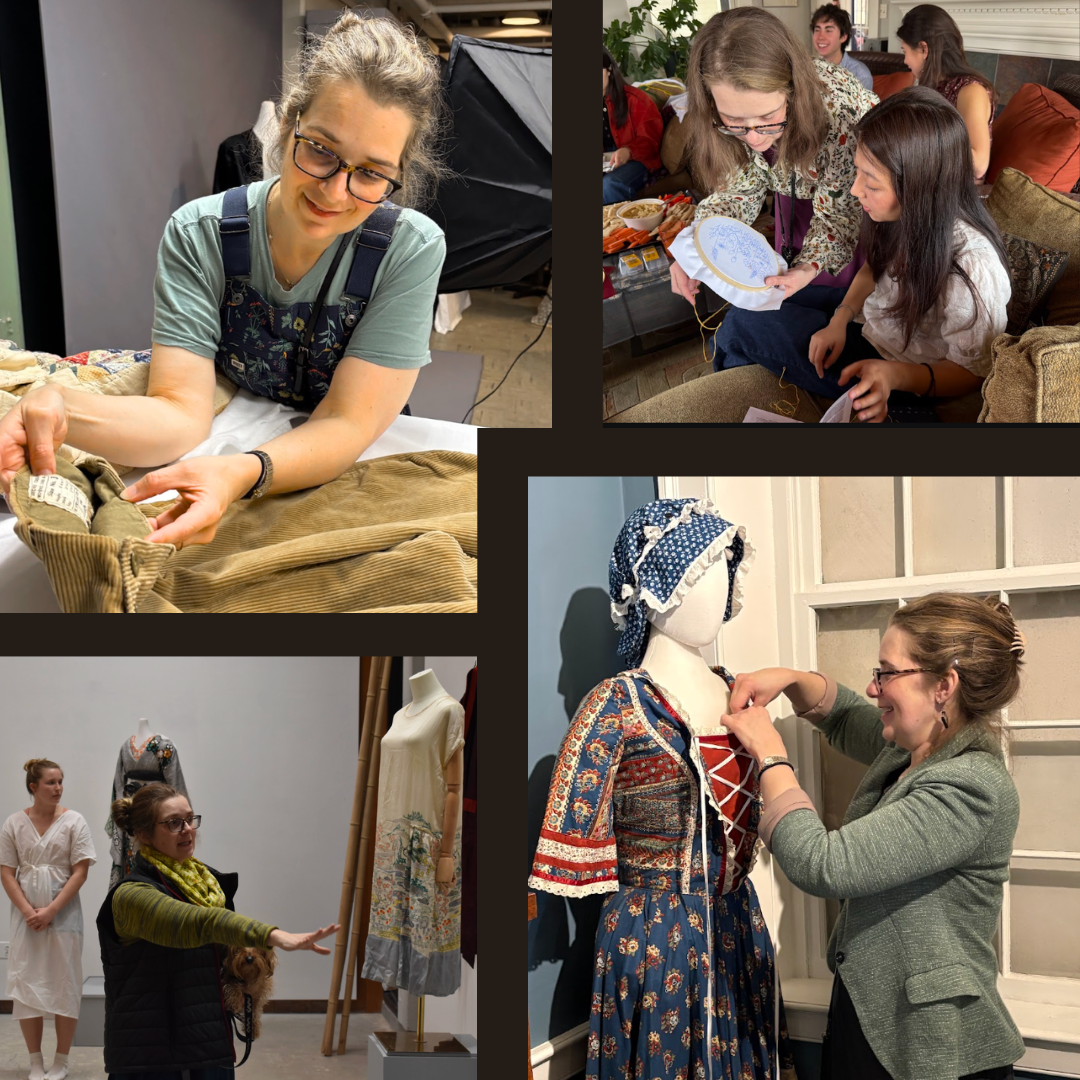
My predecessor established what became the Middlebury College Antique Clothing Collection. Many of these garments originally came from our costume stock, but they became too fragile to continue using on stage. Some of the pieces date back to the 1820s and 1830s, though much of the collection comes from the early twentieth century. Because these garments are so delicate, I've spent a great deal of time teaching myself about textile conservation—how to preserve them so they can continue to be studied and used in classes.
The Costume Society of America has been an incredible resource because it's connected me with people who have much more formal training in conservation than I do. This wasn't something I learned during my MFA. I've been learning how garments should be stored, why hanging them can damage them, how they should be boxed, and how stable temperature and humidity are often more important than the exact temperature itself.
I've also worked with local museums to learn how they care for their collections and to share some of what I've been learning as well.
One of my favorite parts of this work is figuring out how to preserve these objects while still allowing students to experience them. I always joke that it's like tucking them into bed. We carefully wrap them in acid-free tissue paper, support them in archival boxes, close the lid, and let them take a little nap until it's time to bring them back out for class.
One thing I especially love about this collection is that it isn't made up of pristine museum objects. Many of these garments were actually used in theater before becoming part of the collection. It’s a teaching collection. Students can handle them, examine them closely, and look for evidence of the people who once wore them.
What does the future of fashion look like to you?
One thing I've been fascinated by is the way fashion has become increasingly gender neutral. It's interesting to watch that change unfold from the perspective of a costume historian. So much of what I teach focuses on historical distinctions between men's clothing and women's clothing and the different social expectations attached to each. Those boundaries are becoming much more fluid.
Menswear has become more expressive, much like womenswear has been for a long time, and the two increasingly influence one another. Some people continue to embrace traditional ideas of gender in dress, while others have little interest in those distinctions at all. Watching those changes happen in real time is incredibly interesting. To me, that's one of the most exciting things about fashion. It's always people trying to make clothing their own.
___________________________________________________
Thank you so much to Summer Lee Jack for having this conversation with me! You can learn more about her work here.
~Madison Brito Taylor
Images courtesy of Summer Lee Jack