Dialogues on Dress: Charles McFarlane
This month we spoke with Charles McFarlane, costume historian and journalist specializing in military dress.
The history of dress and the future of fashion act in dialogue, always interfacing to inform our present moment. The Costume Society of America’s diverse members exemplify this reality like no other; through the constant connections across time and disciplines they draw, our membership of costume curators, designers, artists, and so much more embody fashion’s ubiquitous presence—and dress’s daily power to teach us all something new.
We hope you will join us for CSA’s new Dialogues on Dress series, interviews now available monthly in our e-News and here on our website.
Interested in getting in touch? Email enews@costumesocietyamerica.com
Dialogues on Dress: Charles McFarlane
Charles McFarlane’s expertise occupies a niche space in our dress lexicon. Niche, but necessary. A harbinger of larger cultural phenomena and an essential piece of fashion history’s full picture, military dress “occupies the same place in American design history as blue jeans or sneakers. It is a foundational element of American style.” There aren’t many journalists with Charles’ specific knowledge set, and his job is somewhat that of a “translator,” uncovering the intersection of military and mainstream American culture, and fashion’s role in that, to a broader audience. His writing no doubt has a broad reach, frequently appearing in the New York Times, GQ, and other major media outlets, in addition to his own Substack, Combat Threads. Topics span from the evolution of special forces guys into mood board staples, MultiCam from SoHo to the world’s armies, and where ICE gets their gear, to Norman Rockwell paintings and obscure bumper stickers. Fans of the popular Articles of Interest podcast may recognize Charles from the recent season “Gear,” in which he served as a consultant and special guest. Whether you already know what a field jacket is or what MultiCam even quite refers to, you will sure care to after reading Charles’ writing.
This interview has been edited and condensed for clarity.
___________________________________________________
Please paint a sketch of your background, personal & professional. How did you get into this work?
My undergrad was a straightforward history degree. I went to a small liberal arts school [Bard College] that required a mini thesis; I’d done some archival research here and there, and my friend had pulled this letter from the Army War College archive, which was basically a memo from a quartermaster general in the European Theater of Operations in World War II. It was essentially talking about field jackets, and really leveling a kind of fashion critique of why he didn't like them. From that, I unlocked this whole story. That turned into writing about the cultural history of field jackets, from their invention in the 1940s going forward. It’s cool you can actually find a birthday for this garment, unlike some other clothing items. There’s a very natural timeline to look at.
After undergrad, I went into the world of media and journalism. I jumped around from editorial to branded content, which was really not for me. When the pandemic happened, I was laid off, which was honestly amazing for me. I had this free space to revisit where I was going and figure out what I wanted. I was freelance writing at the time, doing a lot of essentially men’s lifestyle journalism, but knew I wanted to revisit fashion. I ended up doing NYU’s Master’s in Costume Studies, and I had an incredible time there. My advisor, Rachel Lifter, was an extraordinary advisor—thoughtful, generous, and endlessly supportive. Even now, I go to her for mentorship and more.
My thesis at NYU looked at the intersection of American military uniforms and American popular fashion. My first chapter is about how World War II changed the way uniforms were designed and the process of design generally in a very real way. And then subsequent chapters look at the following decades and what was going on then, like the explosion of the surplus industry or the counterculture movement in the 1960s–how people used military clothing as a political statement against the war in Vietnam. Some of these chapters have turned into Substack articles, but I would love to write a book one day.
Tell me about the many arms of your professional life. What are the differences between writing your Substack and writing for outlets like the NYTimes and GQ, and how do you juggle those different assignments?
I've been freelancing for so long that it's hard to answer what it's like to juggle everything. Honestly, it's mostly just, "I've got to make rent." It has definitely gotten easier over time. Even when I was in graduate school, I was freelancing, although much less than I am now. That was how I was making my living while I was in school. As for switching between writing for different places, with the exception of the editing process, it really isn't that different for me. I always want to tell a compelling story. I try to think of every piece as having characters. My Substack is basically my notebook dump, and a lot of the stories I write there eventually become something else. One thing that is interesting and sometimes frustrating is how different the rules are for interviewing people in an academic setting versus a journalistic one; if I interviewed someone for a New York Times story, I could cite that published article in my thesis. But if I wanted to interview those same people directly for my thesis, I'd have to jump through all these institutional hoops. It literally is easier to write the story first, publish it, and then cite myself.
I'm fortunate now to have really good relationships with editors, which has made freelancing easier over time. Some of them read my Substack, and if something catches their attention, they'll say, "Could we tweak this? Could we develop it into something for us?"
~I think a lot about viewing the soldier as a consumer and the military as its own fashion system. Very early on, I realized my background in military history wasn't something many people in fashion or style spaces had. Whether it was GQ or the NYU Costume Studies program, that perspective was relatively uncommon. A lot of that comes from the military-civilian divide in this country. [...] Over the last decade we've increasingly seen military culture intersect with mainstream American culture. I think part of my job is translating some of that for a broader audience.~
What is it about military dress specifically that keeps you interested?
I started with an existing interest in military history, not really generals or strategy, but specifically the average soldier's experience during World War II. Dress practices and material culture fascinated me. I also came out of a reenacting community and was very involved in that for years. To some extent, I still am. That really trained me to think about clothing and material culture in a way that ended up serving me well academically. There's the official uniform—but then there are all the different ways people actually wear it.
I think a lot about viewing the soldier as a consumer and the military as its own fashion system. Very early on, I realized my background in military history wasn't something many people in fashion or style spaces had. Whether it was GQ or the NYU Costume Studies program, that perspective was relatively uncommon. A lot of that comes from the military-civilian divide in this country. It's geographic, cultural, and it's also a consequence of having a relatively small volunteer military. Over the last decade we've increasingly seen military culture intersect with mainstream American culture. I think part of my job is translating some of that for a broader audience. There's almost an anthropological aspect to what I do, although I wouldn't claim anthropology as my field. We have these two cultures, and I think it's valuable for someone to be able to speak to both.
I'm fortunate now to have a lot of friends who have served or are currently serving in the military, which isn’t something many style writers have access to. I remember someone I knew was writing a story about Zyn nicotine pouches, and I asked, "are you talking to anyone in the military?" Because that's where so much of that culture started. That hadn't even been on their radar. That's a good example of how separate these worlds often are.
Without getting too philosophical about it, I think the military exists to serve the interests of the citizens. Because of that, civilians absolutely should feel entitled to have opinions about the military. It's their military, and I think we've lost sight of that in the post-9/11 era. Military history, as a field, is also dominated by people with prior military service, particularly men; there are understandable reasons for that. Military history PhD programs can be difficult to break into if you haven't served. But I also think we lose something if we don't make room for outside perspectives. Over the years, the military has become less intellectually diverse. Ironically, one of the things that made it so successful during World War II was exactly the opposite. You had people from all over the country—people who never imagined themselves succeeding in the military—bringing different skills and perspectives.
I think about the 1943 field jacket. It was the product of a French immigrant teaching at Harvard Business School who ended up running the Quartermaster Corps, along with Jewish tailors from Philadelphia and New York, an alpinist from Harvard, and all these different people bringing unique expertise together. The result was something uniquely American. The field jacket really didn't exist before that, and almost everything that came afterward is derived from it. To me, military clothing occupies the same place in American design history as blue jeans or sneakers. It is a foundational element of American style.
~To me, military clothing occupies the same place in American design history as blue jeans or sneakers. It is a foundational element of American style.~
What does a typical day of work look like for you? Or perhaps an ideal day?
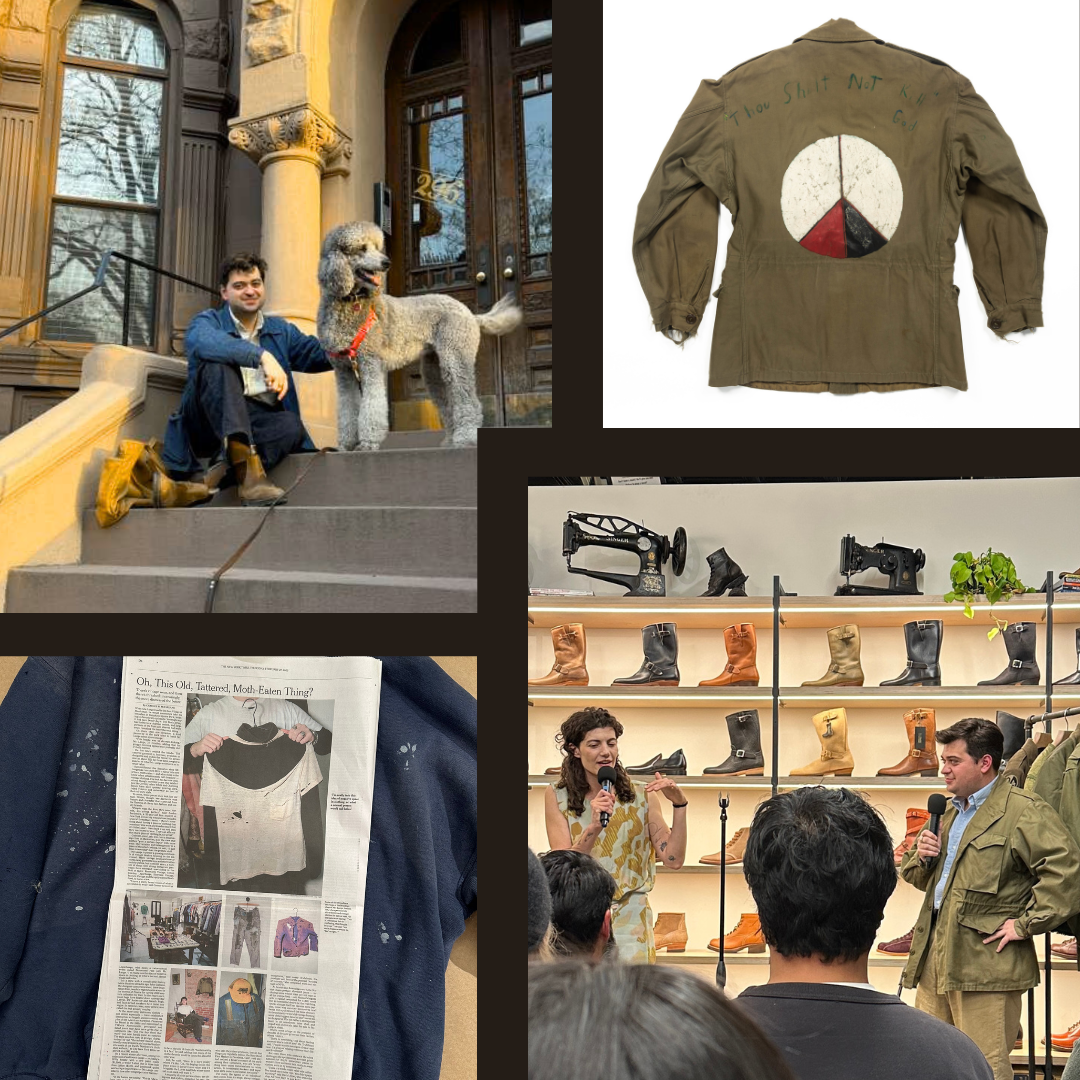
One of the things about freelancing is that, as another freelancer once told me, every month starts as an empty pie. You know how much money you need to make that month, and then you figure out how to carve that pie into different projects that add up. One of my regular jobs is doing work for a men's clothing store called Standard & Strange, which is a small retailer with locations in the Bay Area, New York, and Santa Fe, and they specialize in Japanese menswear. They carry brands like The Real McCoy's, which makes incredibly high-end reproductions of American military uniforms for a fashion audience. So, a typical day might involve going into the store and shooting video content, which is what I've been doing for them recently.
A constant for me in every work day is that I’m always looking for stories. I read trade publications, especially those related to the military; I spend time on Reddit; I'm also a huge fan of Facebook, which is something people never expect. The number of story ideas I've found on Facebook is unbelievable–it’s such a universal platform, and you can find communities dedicated to almost anything. There's a group I follow devoted entirely to old hiking photographs, where people post pictures from the 1960s and 1970s, sometimes even earlier. It has over 10,000 members sharing material like that; communities like that are incredible resources.
Yesterday was actually an example of a good day. An editor I work with at GQ emailed me about the new Punisher movie and asked whether there might be a story about the Punisher skull logo. The logo has become popular in certain police circles, some military circles, and it has developed strong right-wing associations as well. So, we spent a while on the phone throwing ideas back and forth until we found something that felt promising. That's a pretty typical example of how stories develop and pieces start.
~I think Poster House on 23rd Street is a criminally underappreciated museum. I've worked with them for years, and I'm always impressed by their exhibitions. They consistently make me think differently about visual culture, and those ideas often find their way into my writing later.~
What are some of your favorite places in New York? Arts, fashion, coffee shops, anything like that.
One place that's probably pretty obvious is the New York Public Library. I wrote most of my graduate thesis in the main reading room there. As a freelancer, I don't have an office, so anything that gets me out of the house and into a productive environment is really valuable. I think
Poster House on 23rd Street is a criminally underappreciated museum. I've worked with them for years, and I'm always impressed by their exhibitions. They consistently make me think differently about visual culture, and those ideas often find their way into my writing later.
I'm curious about your personal relationship with fashion—what role it plays in your own life and how you like to dress.
That's a surprisingly difficult question. I think my answer probably says more about why I cover the things I cover than anything else. By the time I got to high school, I was trying to figure out my own personal style, just like everyone else. I was fortunate to attend a very small, alternative high school in NYC, so I was surrounded by people who were already expressing themselves in really individual ways. I basically did a speed run through twentieth-century fashion. At one point I dressed like I thought someone from the Dust Bowl in the 1930s would dress. Then I dressed like a teenager in the 1950s, etc. I definitely stood out. Around that same time, the heritage menswear movement was really taking off, and J.Crew played a huge role in popularizing a lot of that style. My first job in high school was working at the J.Crew Men's Shop on 79th Street and Madison Avenue, which also definitely shaped the way I dressed. Today, I'd say I dress in a way that could plausibly fit almost any period between the 1940s and the 1970s, but not in a costume-y way. I wear a lot of workwear and classic prep, mixing those influences together. I try very hard not to buy new clothing anymore, but not necessarily for ethical reasons. Honestly, shipping vintage clothing from Japan to New York might create more of a carbon footprint than buying something from Zara, I don’t know. I just simply prefer older clothing, and when I do buy something new, I try to make it count. A lot of that comes from Standard & Strange. Brands like The Real McCoy's are very much my speed.
Do you ever collect vintage military pieces—not just to wear, but simply because you're interested in them?
Absolutely. I have a pretty serious collection, and that’s a huge part of my practice. I have a large collection of field jackets. I joke with my fiancée that if anything ever happens to me, she should call a few specific people because there's real money tied up in those jackets. I really love the hunt itself and spend a lot of time on eBay, Grailed, and Poshmark. I'm checking those sites multiple times every day.
I wear some but not everything of what I collect. A lot of pieces stay in storage because they're especially important, but every once in a while, I'll pull something out and wear it. It's actually pretty rare that I'll buy something if I know it doesn't fit me, and I’m not looking for pristine examples. I'm much more interested in military garments that clearly show evidence of someone's life, and I want pieces that someone modified and made their own. For example, I have a World War II U.S. Army ski parka that was originally designed as a reversible pullover. At some point after the war, someone cut it open, installed a zipper, and added Inuit-inspired floral ribbon trim across the shoulders. They transformed it into something practical and personal. I absolutely love pieces like that.
~I haven't perfected the elevator pitch yet for this new book idea, but if you look across my work over the last several months, there's a recurring theme: the legacy of the Global War on Terror and the ways it continues to shape military dress, law enforcement, and popular culture. The book would examine how twenty-five years of continuous war have influenced everything from movies and television to military uniforms, police equipment, and everyday fashion.~
Tell me about where you see your work going in the future. You mentioned wanting to write a book. What's a dream project?
I've actually started working on a book proposal. It's still in the very early stages. For now, I've intentionally set my thesis project aside because I think that work will always be there. I was also fortunate enough to work on the Articles of Interest podcast recently, which ended up covering a lot of the same territory that my thesis explored. Working with Avery [the podcast producer and host] was incredible. She gave me a lot of room to contribute. If you've listened to the most recent season, I was the consulting researcher for it. I gave notes throughout the process, and she was incredibly generous about incorporating many of my suggestions. I also appear throughout the series. The whole thing happened because I was finishing my thesis when I heard Avery mention on another podcast that her next season would focus on military clothing and outdoor gear. I immediately cold-emailed her, introduced myself, explained what I was researching, and said, "If you're going to talk to someone about this topic, it should probably be me." My first instinct had actually been, "I need to finish my own project before someone else covers this." But then I realized Avery was going to make a fantastic series whether I was involved or not. So instead of competing with it, I thought, "Why not help make it as good as it can be?" That sounds a little narcissistic when I say it out loud, but I genuinely think I was the right person to contribute to that project, and I'm incredibly grateful that Avery was so open to bringing me into the process. It was an amazing experience.
But back to your earlier question! I haven't perfected the elevator pitch yet for this new book idea, but if you look across my work over the last several months, there's a recurring theme: the legacy of the Global War on Terror and the ways it continues to shape military dress, law enforcement, and popular culture. The book would examine how twenty-five years of continuous war have influenced everything from movies and television to military uniforms, police equipment, and everyday fashion. It often feels like we're living through a cultural hangover from those wars. Most people are familiar with the idea of the "imperial boomerang"—the notion that the practices developed abroad eventually return home in the form of surveillance, policing, or violence. I think something similar happens culturally. We're living through an imperial boomerang of culture as well. Even though many people feel those wars are over, we're still surrounded by their influence. That's really the core idea I'm trying to explore.
Do you have a favorite military uniform from history?
I have to say the 1943 field jacket and the uniform system that surrounded it; it's so distinctly American, and represents the best version of what American design could be. One thing that's often overlooked about military uniform design is that, for much of history, uniforms weren't really designed around the well-being of the individual soldier. The 1943 field jacket represented a shift toward designing clothing that genuinely served the person wearing it. To me, that reflects the citizen-oriented and egalitarian ideals that were central to the U.S. military during that period.
~For the last couple of decades, MultiCam camouflage has become the dominant camouflage pattern almost everywhere in the world. It's remarkable. In Ukraine, for example, both Russian and Ukrainian soldiers often wear essentially the same camouflage pattern, to the point that they rely on brightly colored armbands to distinguish one another. At some point you have to ask: what exactly is camouflage accomplishing if everyone is wearing the same thing?~
What does the future of fashion look like to you? Or maybe, for you specifically, what does the future of military dress look like?
I think I can answer the military question more confidently. To be honest, maybe it sounds strange, but I'm not especially interested in fashion in the conventional sense anymore. When something like the Met Gala happens, I honestly couldn't care less. The same goes for conversations about luxury brands, executive appointments at LVMH, or industry gossip. To me, that has become almost like sports for fashionable people. It just doesn't have much bearing on how ordinary people actually dress. I think we're living through a period of cultural stagnation. Fashion feels sluggish, and everything is increasingly driven by consolidation and intellectual property. It's become much harder for genuinely new ideas to emerge.
But military dress—that's something I can speculate about all day. For the last couple of decades, MultiCam camouflage has become the dominant camouflage pattern almost everywhere in the world. It's remarkable. In Ukraine, for example, both Russian and Ukrainian soldiers often wear essentially the same camouflage pattern, to the point that they rely on brightly colored armbands to distinguish one another. At some point you have to ask: what exactly is camouflage accomplishing if everyone is wearing the same thing? I think we've probably reached peak MultiCam. When the same camouflage appears on American soldiers, Russian soldiers, the Taliban, Hezbollah, and countless other armed groups, it has effectively become universal. So, I think something different has to come next. Personally, I wouldn't be surprised if we saw a return to solid-colored uniforms. Maybe military uniforms will move back toward simpler greens, grays, and earth tones rather than highly specialized camouflage patterns. Not because camouflage disappears entirely, but because modern militaries increasingly need uniforms that work across many different environments. If we're serious about strategic shifts toward the Pacific or the Arctic, then armies will be operating across radically different landscapes. It becomes much harder to justify extremely environment-specific camouflage when conflicts may span deserts, forests, cities, mountains, and snow. A simpler, more adaptable system may ultimately make more sense.
___________________________________________________
Thank you so much to Charles McFarlane for having this conversation with me! You can find his Substack here, and more of his writing here or here.
~Madison Brito Taylor
Images courtesy of Charles McFarlane